

Liver Foundation
Services offered
Cancer information
Support from cancer nurses
Emotional support
+2
Some people with liver cancer have surgery to remove some or all of the liver.
A liver resection removes part of the liver. Sometimes, a procedure called a portal vein embolisation (PVE) is used before a liver resection. A PVE helps the healthy part of the liver grow bigger.
A liver transplant removes the whole liver and replaces it with a healthy liver from a donor.
Liver surgery aims to remove all the cancer from the body. This may be done by removing the part of the liver affected by cancer (known as a liver resection or partial hepatectomy) or by removing the whole liver and replacing it with a liver from a donor (liver transplant). Your surgeon will talk to you about the most appropriate surgery for you, as well as the risks and any possible complications.
There are risks associated with any type of surgery. A surgeon needs your agreement (consent) before performing the operation. Receiving relevant information about the benefits and risks of surgery before agreeing to it is called informed consent.
The aim of a liver resection is to remove all cancer from the liver, as well as a margin of healthy tissue. Liver resection is usually performed in a specialist treatment centre.
A liver resection is suitable for only a small number of people with liver cancer. The liver needs to repair itself after the surgery, so a resection is only an option when the liver is working well. Some people need to have a procedure called a portal vein embolisation to help the healthy part of the liver grow bigger before the liver resection
People with no or early cirrhosis may be considered for surgery, but it is unlikely that people with more advanced cirrhosis will be offered surgery. Surgery is also not suitable for people with ascites or when the cancer has spread to major blood vessels.
The surgeon will consider the size and position of the tumour, as well as the health of the liver, to work out how much of the liver can be safely removed. The liver resection may be called a right or left hepatectomy (removes the right or left part of the liver) or a segmentectomy (removes a small section of the liver). In some cases, the gall bladder may also be removed, along with part of the muscle that separates the chest from the abdomen (the diaphragm).
Before your treatment begins, your treatment team may suggest that you exercise, eat a healthy diet, or speak to a counsellor about how you feel. If you smoke, you will be encouraged to stop. Research shows that quitting smoking before surgery reduces the chance of complications. Preparing for treatment in this way – called “prehabilitation” – may help your recovery.
If you have a liver resection, it will be carried out under a general anaesthetic. There are two ways to perform the surgery:
People who have laparoscopic surgery usually have a shorter stay in hospital, less pain and a faster recovery time. However, laparoscopic surgery is not suitable for everyone with primary liver cancer and it is not available in all hospitals. Both open surgery and laparoscopic surgery are major operations – talk to your surgeon about the best option for you.
The portion of the liver that remains after the resection will start to grow, even if up to two-thirds of the liver has been removed. It will usually regrow to its normal size within a fewmonths, although its shape may be slightly changed. After surgery:
Learn more about cancer surgery.
Sometimes, the surgeon needs to remove so much of the liver that the remaining portion may not be large enough to recover. In this case, you may have a portal vein embolisation (PVE) about 4-8 weeks before the liver resection.
A PVE is performed by an interventional radiologist and is normally done under local anaesthetic.
A PVE blocks the branch of the portal vein that carries blood to the part of the liver that is going to be surgically removed. Blocking the blood supply allows the other part of the liver to grow bigger.
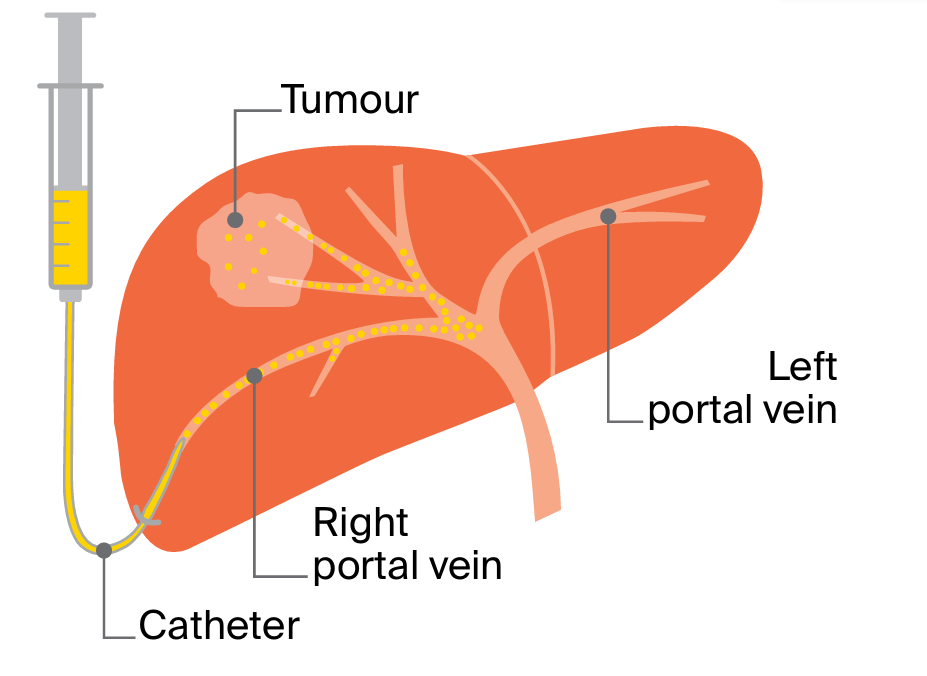
1. The interventional radiologist inserts a tube (catheter) through the skin. Using ultrasound as a guide, a dye is injected to identify the portal vein. Then the targeted branch will be blocked with tiny plastic beads, soft gelatine sponges or metal coils.
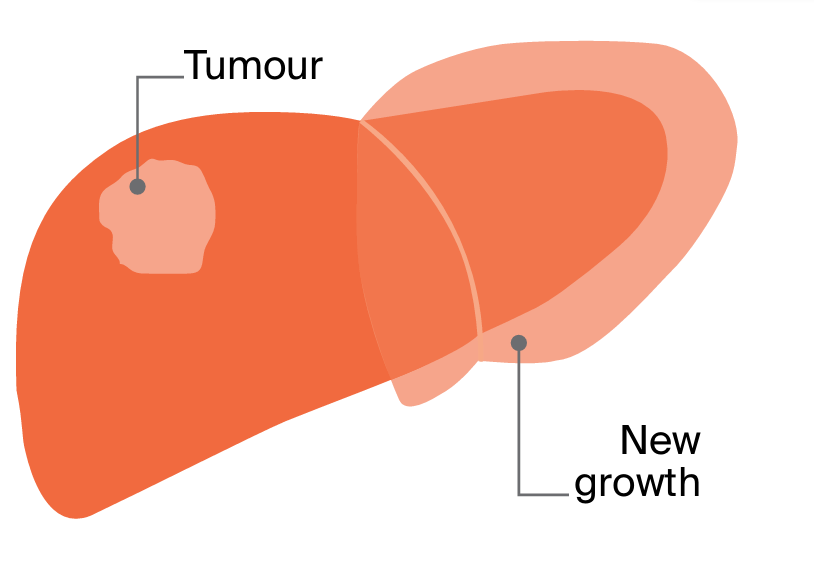
2. Blood is redirected to the part of the liver that will be kept to help it grow.
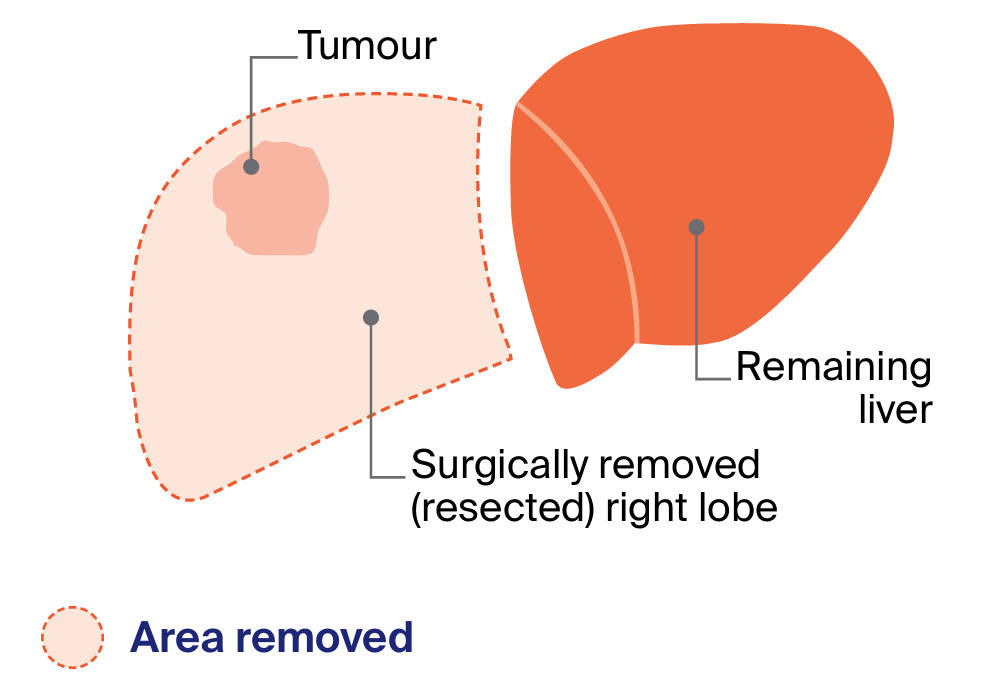
3. After 4-8 weeks, you will have a CT scan to measure the size of your liver. If the liver has grown enough to safely do a liver resection, the surgeon will remove the part of the liver with the tumour.
A liver transplant can be an effective treatment for some people with primary liver cancer. It involves removing the whole liver and replacing it with a healthy liver from another person (a donor). However, liver transplants are suitable for only a small number of people. Those with a single tumour or several small tumours may be able to have a transplant. A liver transplant may also be considered if other therapies such as transarterial chemoembolisation (TACE) can shrink the tumour first. This is called downstaging.
To be considered for a liver transplant, you also need to be reasonably fit, not smoke or take illegal drugs, and have stopped drinking alcohol for at least six months.
Liver transplants are not possible when the cancer has spread (metastasised) to other organs or to major blood vessels.
Currently, all liver transplants in Australia are performed in public hospitals and there is no cost for in-hospital services. You will usually have to pay for any medicines you continue to take once you leave the hospital after the transplant.
Donor livers are scarce and waiting for a suitable liver may take many months or even several years. During this time, the cancer may continue to grow. As a result, most people have tumour ablation or TACE to control the cancer while they wait for a donor liver to become available.
Unfortunately, in some people the cancer progresses despite having tumour ablation or TACE, and a liver transplant will no longer be possible. If this happens, you will be taken off the liver transplant waiting list and your doctor will discuss other treatment options.
If you have a liver transplant, you will spend up to three weeks in hospital. It may take 3-6 months to recover and it will probably take time to regain your energy.
You will be given medicines called immunosuppressants to stop your body rejecting the new liver. These drugs need to be taken for the rest of your life. The Liver Foundation has more information on liver transplants.
Liver Foundation
Services offered
Pancare Foundation
Services offered
Find the right services for your needs, wherever you are in Australia
Trusted cancer information for all people affected by cancer
We're available 9am - 5pm, Monday to Friday (excluding public holidays)