
Overview
Breast implants are usually made of silicone gel to create a breast shape.
The surgery for this type of reconstruction may be done in one stage, if the surgeon puts in the implant during the mastectomy, or in two stages, if there needs to be tissue expansion before the implant is placed.
Your surgeon will discuss the risks of implant reconstruction with you, and there is a national registry to help you stay up to date on the safety of breast implants.
What's on this page

What is an implant reconstruction?
An implant reconstruction uses a sac filled with silicone gel or saline to create a breast shape. You may have an implant reconstruction as a one-stage or two-stage operation.
In the one-stage operation, the surgeon puts in a permanent implant during the mastectomy. In the two-stage operation a tissue expander is used to inflate and stretch the skin so there is room for the implant. A tissue expander is used for some people whose skin may need this expansion step in the process, or if you want to significantly increasethe size of the reconstructed breast compared to the breast size before.
There are benefits and drawbacks to having an implant.
Types of implants
All implants are made with an outer layer (shell) of silicone. They can be filled with silicone gel or saline (salt water).
Silicone gel implants
Silicone gel implants
These are used in almost all implant reconstructions. Implants are now made with a soft, semi-solid filling called cohesive gel. This gel is quite firm and holds its shape like jelly. A softer, honey-like type of gel was previously used.
The surface of these implants can feel smooth or have a rough (textured) surface. The rougher textured implants are called macro textured; the less textured implants are called micro textured. Textured implants grip to tissue better and are less likely to move position than smooth implants. Some textured implants have been removed from sale because of a rare side effect called BIA–ALCL.
Saline implants
Saline implants
These are no longer commonly used in breast reconstruction. Saline breast implants don’t look and feel as natural as silicone implants. They may wrinkle under the skin and may leak. If the saline leaks, the implant deflates and needs to be replaced.
Reconstruction with an implant
Reconstruction with an implant
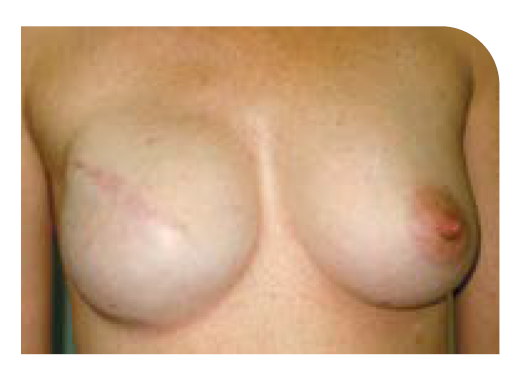
After the reconstruction you will have a scar on your breast. The type of scar will depend on the type of cut (incision) that your breast and reconstructive (plastic) surgeons choose.
What to consider – implant reconstruction
Benefits
Benefits
- The few operation takes only a hours and you usually stay in hospital for only a few days.
- Creates the breast shape without moving tissue (muscle, skin or fat) from another place in the body, so these parts aren’t affected.
- There is only a scar in the breast area from the mastectomy and no scar elsewhere on the body.
- Recovery time at home is shorter than for a flap reconstruction. Although the chest area will be swollen and sensitive, you may be able to return to most activities after 4 weeks. Heavy lifting should be avoided for 6–8 weeks.
- Implants come in a range of shapes and sizes. You can choose to change your original breast size.
- The operation doesn’t usually cause muscle weakness, only temporary discomfort and pressure.
- Having a reconstruction may make you more confident when naked.
Drawbacks
Drawbacks
- May not be suitable if you plan to have radiation therapy.
- Two or more operations may be needed. If you have an expander first, the expander is gradually filled every couple of weeks. The whole process may take 3–6 months.
- A breast reconstructed with a tissue expander usually feels firm and doesn’t move like the original breast, but it usually looks the same in a bra.
- If your other breast changes in shape and size, you may need more surgery to match the 2 breasts.
- Hardened scar tissue (capsule) may form around the implant. This can change the shape of the breast and may be painful.
- There is a risk of infection, which may mean removing the implant.
- Implants may eventually need to be replaced.
- There are some rare side effects.
- There may be an increased risk of lymphoedema (swelling in the soft tissue under the skin).
One-stage operation
This operation is sometimes called a direct-to-implant reconstruction. It is usually done at the same time as a skin- or nipple-sparing mastectomy, when there is enough tissue left on the chest to cover the implant. The surgeon can place the implant above or under the chest (pectoralis) muscle.
Subpectoral implant reconstruction
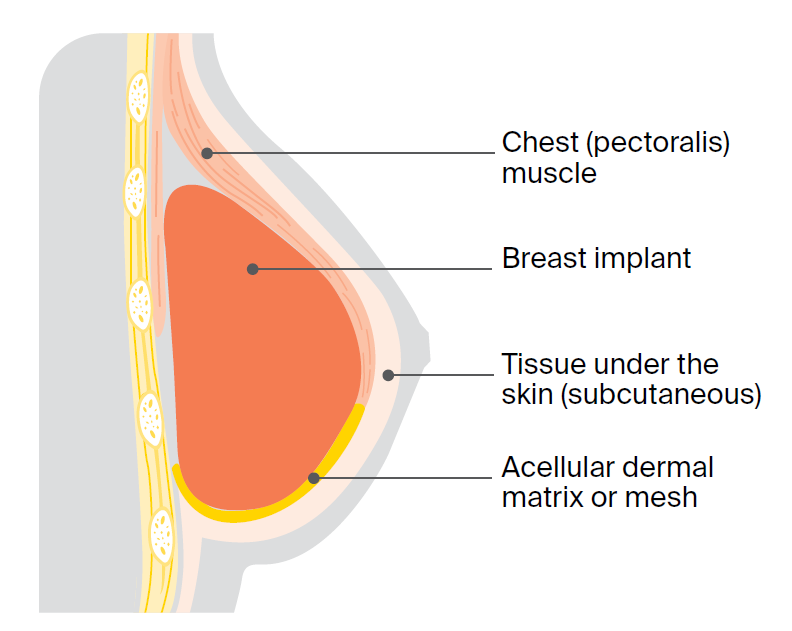
The breast implant is placed under the chest muscle. This is called a subpectoral implant reconstruction. The lower and outer part of the implant is often covered by a material called dermal matrix or mesh to hold the implant in place.
Prepectoral implant reconstruction
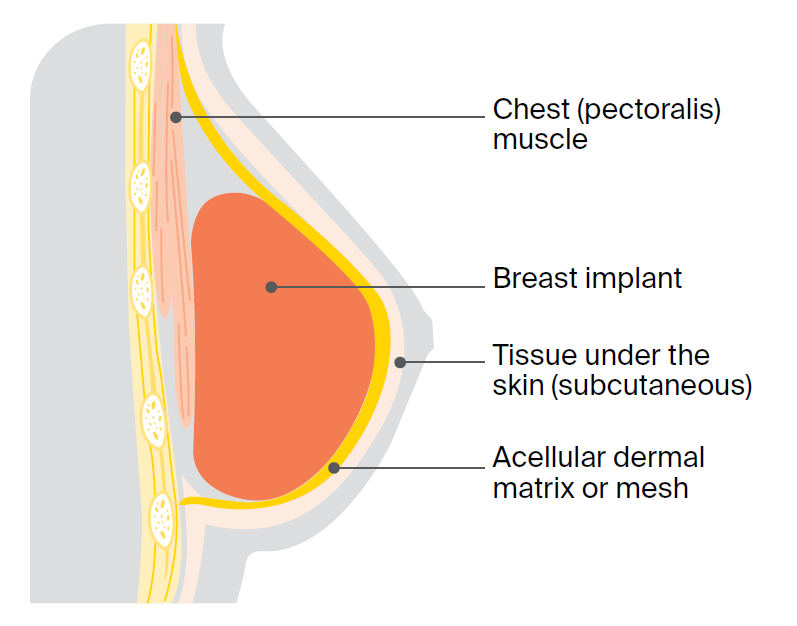
The breast implant is placed in front of the chest muscle, directly under the skin and the layer of tissue just under the skin. This is called a prepectoral implant reconstruction. The whole outer part of the implant is covered by a dermal matrix or mesh to hold the implant in place.
Two-stage operation with a tissue expander
Tissue expansion is a process that stretches the remaining chest skin and soft tissue to fit the breast implant. This is done in two stages. The two-stage approach is often used when radiation therapy is given after a mastectomy and before the implant is put in.
First stage (implanting the tissue expander)
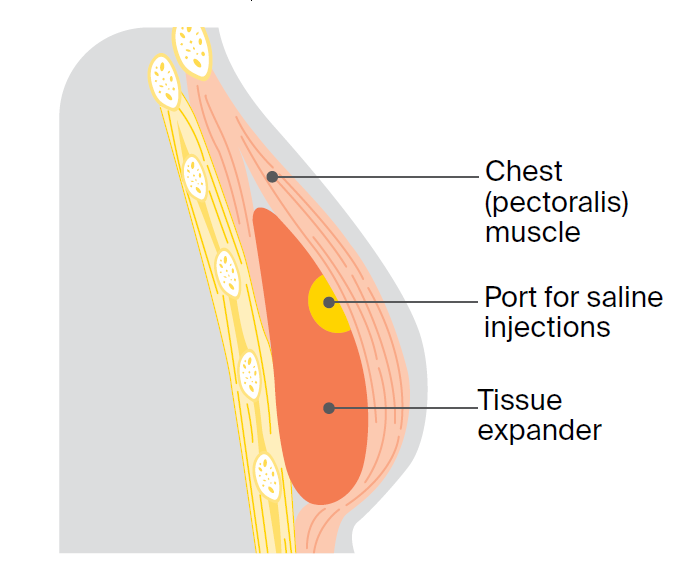
In the first operation, a balloon-like bag called a tissue expander is placed under the chest muscle. In some cases, it is placed in front of the chest muscle. Every couple of weeks, the balloon is injected with saline through a port (a thin tube). You may be given 1–6 injections depending on how much the skin and muscle need to stretch. The stretched tissue creates a pocket for the breast implant. The saline injections are usually not painful.
Second stage (expanding the tissue expander)
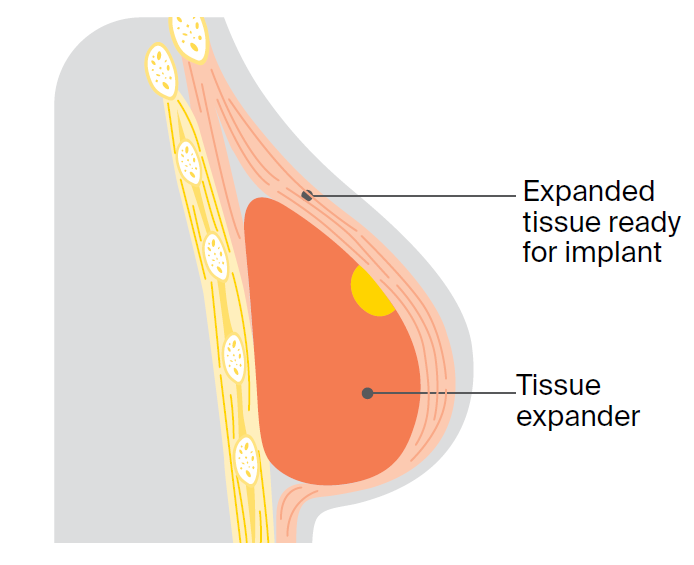
The tissue stretches and expands each time saline is added. You may feel discomfort for a few days. When the expander has stretched the tissue enough, you have a second operation to remove the temporary expander and insert the implant in its place. You may need to stay in hospital overnight after this second operation.
Risks of having an implant reconstruction
Before the operation, the surgeon will discuss the risks of an implant reconstruction with you. Some of these risks are covered below. For information on side effects of breast reconstruction surgery, see What to expect after a reconstruction.
Infection
Infection
You’ll be given antibiotics at the time of the operation to reduce the risk of infection. If you do get an infection, the implant may have to be removed until the infection clears. The implant can then be replaced with a new one.
Implant rupture
Implant rupture
Implants can leak or break (rupture) because the silicone gradually weakens over time. If a saline implant ruptures, salty water will leak into your body. The salty water is not harmful, but you will need to have surgery to remove the empty silicone envelope and replace the implant.
Implants may need to be changed every 10–15 years, or earlier if there are any problems. Regularly examine your breasts, armpit and implant for any changes. See your surgeon or GP every year forcheck-ups, which will include scans.
Hardening of the implant
Hardening of the implant
A fibrous covering can form around a breast implant. If this hardens over time, it may make the reconstructed breast feel firm. This is called capsular contracture, and it is more common after radiation therapy. Capsular contracture can be uncomfortable or painful and may change the shape of the breast. You may need to have additional surgery to remove or replace the implant. A new surgical procedure called capsulotomy can be done to loosen the scar tissue surrounding the implant.
Movement
Movement
The position of the implant in the body may change slightly over time. This is called implant malposition, displacement, descent or rotation. In a small number of cases, the implant shifts a lot and changes the shape of the breast. Further surgery can restore the implant to its original position.
Visible rippling
Visible rippling
Sometimes implants adhere to the surface of the skin and this can affect how smooth the breast is. This can often be corrected with minor surgery, which injects fat from another part of the body under the skin. This is called lipomodelling.
Lymphoma
Lymphoma
There have been reports of a link between a type of non-Hodgkin lymphoma and textured breast implants. This is known as breast implant associated anaplastic large cell lymphoma, or BIA–ALCL, and it is rare. BIA–ALCL is a cancer that grows in the fluid and scar tissue that forms around a breast implant. Implants that have a smooth surface have not been linked to BIA–ALCL. The Therapeutic Goods Administration (TGA) recommends monitoring your breasts for any changes such as swelling, a lump or pain.
For more information about BIA–ALCL, visit the Therapeutic Goods Administration (TGA) and search “BIA–ALCL for consumers”. The TGA also has an online breast implant hub, where information and support related to breast implants and their safety are updated as new evidence becomes available (visit tga.gov.au/hubs/breast-implants). If you are concerned, talk to your surgeon.
Other health problems
Other health problems
Research has not established that silicone breast implants cause autoimmune disorders such as scleroderma, rheumatoid arthritis or lupus. There is also no evidence that implants cause breast cancer.
How to keep up to date about the safety of your breast implants
While implants are generally considered to be safe, there have been some concerns about risks.
Some silicone implants were voluntarily taken off the market in the 1990s due to safety concerns. Since then, regulatory authorities such as the Therapeutic Goods Administration (TGA) must approve brands that are used in Australia.
In April 2010, the French breast implant brand Poly Implant Prothèse (PIP) was withdrawn due to safety concerns and a possible increased likelihood of ruptures. About 5000 Australians had a PIP implant between 2000 and 2010, most of which were cosmetic procedures.
In late 2019, the TGA removed from sale some textured breast implants. The TGA also imposed extra conditions on other implants due to concerns over BIA–ALCL.
The Australian Breast Device Registry (ABDR) is a national clinical quality registry for all people having breast implant surgery. Its aim is to provide a way to track the long-term safety and performance of breast implants. This can help identify early signs of problems with a device.
ABDR is supported by the Australian Society of Plastic Surgeons, Breast Surgeons of Australia and New Zealand, and the Australasian College of Cosmetic Surgery and Medicine. Your surgeon will provide you with printed information about the registry and you’ll be contacted by ABDR after the surgery with more information.
For more details on ABDR, visit Australian Breast Device Registry (ABDR) or ask your surgeon. For updated safety information, visit tga.gov.au/hubs/breast-implants.
Discuss any concerns you have about the safety of your implant with your surgeon.
Find support services
Find the right services for your needs, wherever you are in Australia
Read cancer information
Trusted cancer information for all people affected by cancer
Need to talk to someone?
We're available 9am - 5pm, Monday to Friday (excluding public holidays)