
Overview
A flap reconstruction (or autologous reconstruction) uses your own muscle, fat and skin to create a breast shape.
It’s most common to use tissue from the tummy but it can also be taken from the back, bottom and thighs.
This type of surgery may not be suitable for you if you smoke, have diabetes or other health conditions.
What's on this page

What is a flap reconstruction?
The shape of a breast can be built using your own muscle, fat and skin, which is taken from another area of the body. This is called a flap or autologous reconstruction.
There are different types of flap reconstructions. Most use a flap of tissue from the tummy (abdomen). But tissue can also be taken from the back, bottom and thighs. See below for more details.
Your surgeon will discuss the type of flap reconstruction that is most suitable for you.
This may depend on if you:
- have large breasts
- don’t have enough skin to cover an implant
- have had radiation therapy.
A flap reconstruction may not be suitable for you if you smoke; have diabetes, connective tissue disease or vascular disease; have had previous major abdominal surgery; or have a higher BMI.
There are benefits and drawbacks to having a flap reconstruction – see What to consider – flap reconstruction for more details. You need to discuss these with your surgeon. They can also tell you how long the operation will take and the expected length of your recovery.
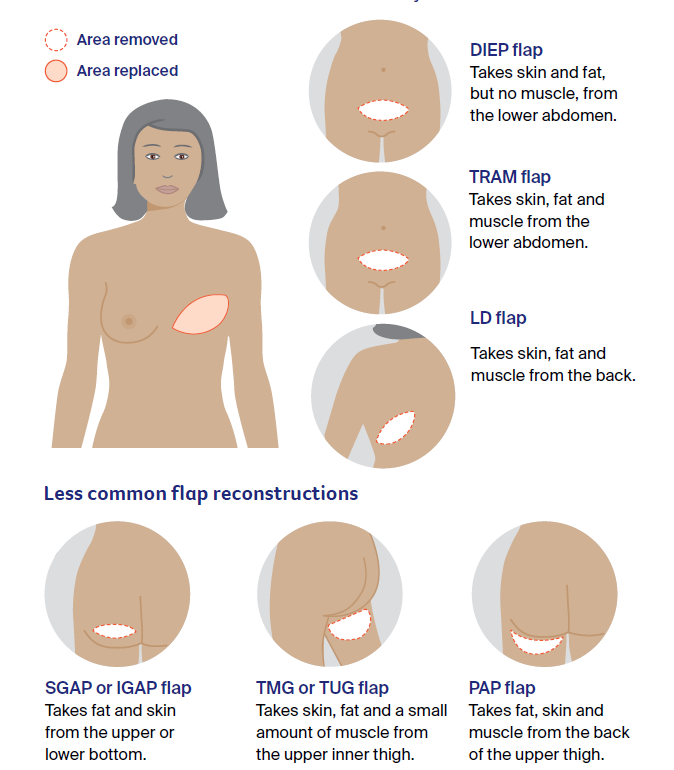
Location of flap reconstructions
Location of flap reconstructions
The tissue for reconstructing your breast can come from different places. Your doctor will discuss the best location with you.
What to consider – flap reconstruction
Benefits
Benefits
- Flap reconstruction is permanent once the breast has healed.
- Most methods use only your own living tissue to create the breast. This often gives a better match to the other breast. This may be important to you, especially when you are naked.
- The flap maintains its look and feel over the long term and generally adjusts if your body’s weight changes.
- Using your own tissue means there is no risk of possible rupture.
- There is less chance of long-term complications.
- If you have a flap reconstruction, you are less likely to need further surgery in the future than you would if you have an implant reconstruction.
- Having a reconstruction may make you more confident when naked.
Drawbacks
Drawbacks
- Flap reconstruction is more extensive than implant reconstruction. Additional treatment or follow-up surgeries are sometimes needed. The operation will take several hours and you may need to stay in hospital for about a week.
- Recovery takes longer than after an implant reconstruction as there are 2 wounds that have to heal – a wound at the site where the flap was taken and a wound on the breast that was reconstructed.
- Risks include infection and the flap not healing properly.
- Surgery usually causes more than one scar (but these fade).
- Depending on the type of flap, you may also need an implant.
- DIEP and TRAM procedures can be done only once.
- There is a small risk of hernia with abdominal flaps.
Flap from the lower abdomen (DIEP or TRAM flap reconstruction)
Tissue from the lower abdomen (tummy) is used to reconstruct the breast shape. There are 2 main types of abdominal flaps: free deep inferior epigastric perforator (DIEP) flap, and free transverse rectus abdominis myocutaneous (TRAM) flap.
These flaps are called free flaps because the flap is cut completely away from the blood supply in the abdomen. The surgeon then reconnects the flap to the blood vessels in the chest area using microsurgery (surgery using miniature instruments and viewed through a microscope).
DIEP flap reconstruction
DIEP flap reconstruction
This is called DIEP because it uses deep blood vessels called deep inferior epigastric perforators (DIEP). It is now done more often than TRAM flap procedures.
In a DIEP flap procedure, the surgeon uses only the skin and fat to reconstruct the breast. The abdominal muscle is left in place. This means the strength of your abdomen muscle is less affected and the risk of abdominal problems after surgery is reduced.
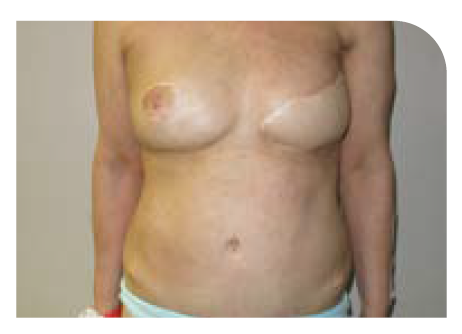
Reconstruction with a DIEP flap
After the reconstruction you will have a scar on your breast and a scar across your abdomen from one hip to the other (seen only faintly here).
TRAM flap reconstruction
TRAM flap reconstruction
In this procedure, all or some of the muscle in the lower abdomen and a flap of skin and fat are used to reconstruct the breast shape. The muscle in the lower abdomen that runs from the breastbone to the pubic bone is the rectus abdominis muscle, or “six pack” muscle.
A type of TRAM flap reconstruction that is not often done anymore is called a pedicle TRAM flap. In this procedure, the flap remains attached to its original blood supply and is tunnelled under the skin of the upper abdomen to the breast. A pedicle TRAM flap has a high risk of hernia.
How the abdomen will look after reconstruction
How the abdomen will look after reconstruction
After a DIEP or TRAM flap reconstruction, your abdomen is tighter and flatter. This is because the reconstructed breast is formed from tissue taken from the abdominal area.
You will have a long scar across the lower abdomen from one hip to the other, a scar around your bellybutton and a scar on the reconstructed breast. While everyone heals differently, the appearance of the scars will improve with time.
Both types of flap reconstructions can make the abdominal area weaker, and you will have little to no feeling in the skin over the breast and the scar over the abdomen. You may be advised to wear a garment called an abdominal binder to protect and support the wound. Ask your surgeon how long you will have to wear the binder.
Try to look at your new breast shape as soon as possible. Breast care nurses often advise looking down at your breast first and then looking in the mirror. This may help you prepare for the change. A breast care nurse can do this with you.
Flap from the back (LD flap reconstruction)
The latissimus dorsi (LD) is a muscle on the upper back that controls shoulder movement. This muscle and some skin and fat can be moved from the back around to the chest to reconstruct the breast shape.
This reconstruction can be completed in one operation, but the surgeon will usually place an implant under the flap to create a breast that is similar in size to your remaining breast. If you have a tissue expander, the surgeon will begin the expansion process after the flap has healed. Unless you have a nipple-sparing mastectomy, the areola and nipple are created in a separate operation.
The size of the scar on the back will depend on the surgeon – most times it can be hidden by a bra strap. The scar on the breast will vary depending on the type of mastectomy you had.
A new technique avoids a scar on the back by reopening the mastectomy scar and then special instruments are inserted to bring the latissimus dorsi muscle forward towards the breast. This surgery is now widely available. Ask your surgeon if this is suitable for you.
Reconstruction with an LD flap
Reconstruction with an LD flap
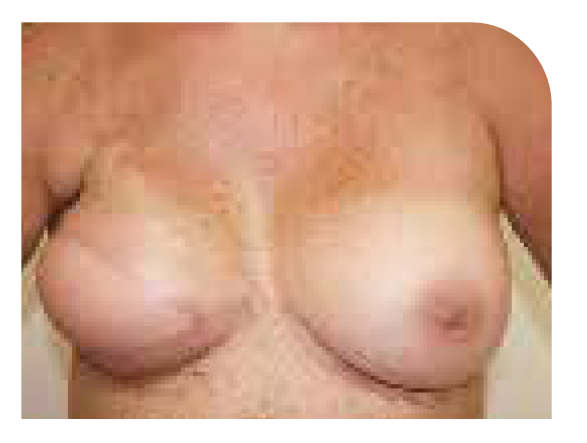
Reconstruction with an LD flap
After the reconstruction you will have a scar on your breast. You may also have a scar on your back, depending on the technique used.
Less common types of flap procedures
If a DIEP, TRAM or LD flap is not suitable, you may be offered reconstruction techniques that use fat and a blood supply from another area of the body. These include:
- superior gluteal artery perforator (SGAP) flap or inferior gluteal artery perforator (IGAP) flap using tissue from the bottom
- transverse myocutaneous gracilis (TMG) flap, transverse upper gracilis (TUG) flap or profunda artery perforator (PAP) flap using tissue from the inner thigh.
To help reconstruct a small breast shape, the surgeon may remove fat from another part of the body (liposuction), then inject it into the breast to create or improve the shape and contour.
Risks of having a flap reconstruction
Before the operation, the surgeon will discuss the risks of a flap reconstruction with you. Some of these risks include:
Loss of the flap
Loss of the flap
Blood vessels supplying the flap may kink or get clots, leading to bleeding and a loss of circulation. If there are signs of problems with the blood supply, you might need another operation. If the blood supply is not good enough, this may cause the tissue to die, leading to a partial or complete loss of the flap. Problems with blood supply are more likely to happen if you smoke or have recently quit or are carrying extra weight. If the flap dies, you usually have to wait 6–12 months before having a reconstruction again.
Hardening of the flap
Hardening of the flap
In rare cases, the fat used to make a TRAM or DIEP flap doesn’t get enough blood supply and dies. This is known as fat necrosis. Because it causes the affected area in the reconstructed breast to feel hard, fat necrosis can easily be seen and diagnosed on a mammogram. It can be left in place or surgically removed. Fat necrosis is more likely to happen if you smoke or have had radiation therapy.
Problems with the donor site
Problems with the donor site
After an abdominal flap reconstruction, it may take time for the wound to heal, and fluid can collect (seroma) in the abdominal region. After an LD flap reconstruction, it’s common for fluid to build up (seroma) in the back where the muscle was taken from.
Hernia (abdominal bulge)
Hernia (abdominal bulge)
If you have had a DIEP or TRAM flap, you have a small risk of developing a hernia. A hernia occurs when part of the bowel sticks through a weak point in the abdominal wall. The risk of an abdominal hernia is greater with a TRAM flap than with a DIEP flap reconstruction because removing the TRAM flap can weaken the abdominal wall and cause a hernia. If you have any signs of a hernia, see your doctor.
Find out more about side effects and what to expect after a reconstruction.
Find support services
Find the right services for your needs, wherever you are in Australia
Read cancer information
Trusted cancer information for all people affected by cancer
Need to talk to someone?
We're available 9am - 5pm, Monday to Friday (excluding public holidays)