

Lung Foundation Australia
Services offered
Cancer information
Support from cancer nurses
Emotional support
+1
Breathlessness is a common symptom of both pleural mesothelioma and peritoneal mesothelioma. This is often managed by draining or controlling the build-up of fluid in affected areas.
Other common symptoms of mesothelioma are fatigue, difficulty sleeping, pain, constipation and poor appetite. Most people have treatment to control symptoms and improve their quality of life.
For many people, mesothelioma is diagnosed at an advanced stage, and the main aim of treatment is to manage symptoms and keep them under control for as long as possible. Treating symptoms will help improve your quality of life. Treatment may slow tumour growth, make you feel better and help you live longer. This is called palliative treatment.
Palliative treatment aims to manage the symptoms without trying to cure the disease. It can be used at any stage of advanced cancer to improve quality of life. It does not mean giving up hope – rather it is about living as fully and comfortably as possible. Early palliative care is sometimes also called supportive care.
This section describes treatments and strategies for managing some common symptoms of mesothelioma, such as fatigue, difficulty sleeping, breathlessness, pain, constipation and weight loss. As you may be experiencing several symptoms, you may have a combination of treatments. Keep in mind, however, that you won’t necessarily experience all the symptoms listed here.
If symptoms return after a period of relatively good health, you may be offered a different combination of treatments and strategies.
There are treatments, but there’s no cure. It just gives people a bit more time. At the moment I feel fine. I have my ups and downs and get tired.
It is common to feel tired during and after treatment, and to lack energy for day-to-day activities. Fatigue for people with cancer is different from tiredness, as it may not go away with rest or sleep. You may lose interest in things that you usually enjoy doing or feel unable to concentrate for very long.
If fatigue is a problem, talk to your treatment team. Sometimes fatigue can be caused by a low red blood cell count (anaemia) or the side effects of drugs, and can be treated. While you can’t always avoid fatigue, you can find ways to improve your energy levels.
For more information, see Fatigue and listen to Cancer Council's podcast episode Managing Cancer Fatigue.
Getting a good night’s sleep is important for maintaining your energy levels, reducing fatigue, and improving mood. Difficulty sleeping may be caused by pain, breathlessness, anxiety or depression. Some medicines can also disrupt sleep.
If you had sleep problems before the mesothelioma diagnosis, these could become worse. Talk to your doctor about what might be helpful for you. Medicines you are taking may need adjusting or you may need other drugs to help you sleep. Strategies that may be helpful in improving your sleep quality are listed below.
Shortness of breath, also called breathlessness or dyspnoea, is the most common symptom of pleural mesothelioma. This is often caused by a build-up of fluid in the pleural cavity known as pleural effusion. The fluid can put pressure on the lung, making it harder to breathe.
In the earlier stages of pleural mesothelioma, controlling this fluid build-up will improve breathlessness. The level of improvement will depend on the health of your lungs before diagnosis, and how well they function after surgery. You may also feel breathless because of the cancer itself not allowing the lung to work properly (trapped lung).
In peritoneal mesothelioma, a build-up of fluid (ascites) can cause the abdomen to swell. This can be painful, but also puts pressure on the diaphragm and can make you feel breathless.
Other problems such as infection or a low level of red blood cells (anaemia) can also cause breathlessness. Living with breathlessness can be difficult, but there are ways to reduce its impact on your life and manage it at home (see below).
In pleural mesothelioma, a pleural tap (also known as pleurocentesis or thoracentesis) drains fluid from around the lungs. It may be done before mesothelioma is diagnosed or at the same time as a biopsy.
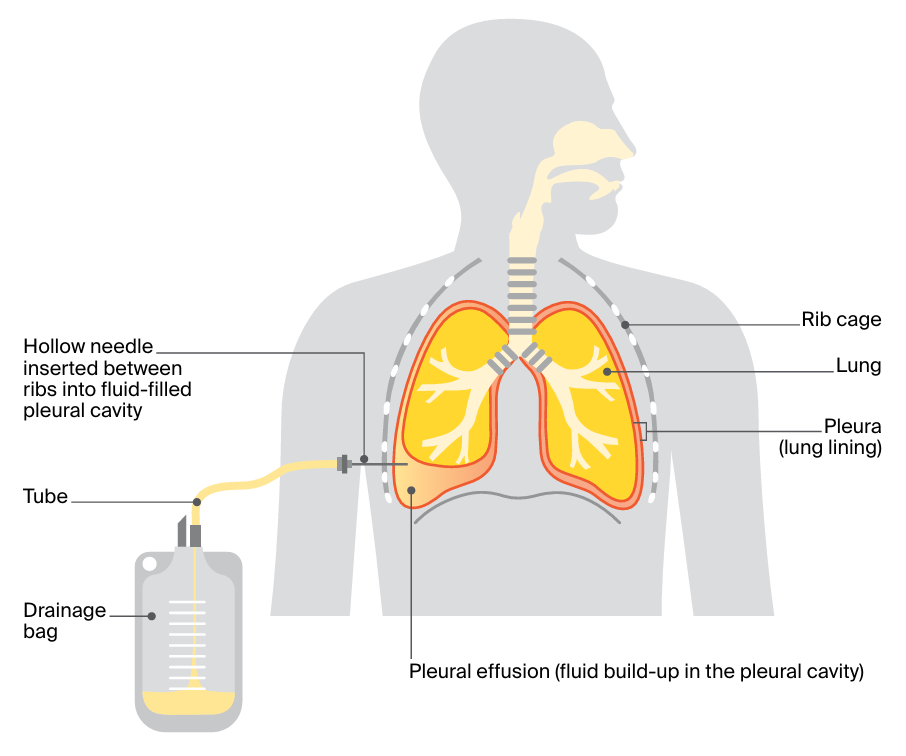
To prevent fluid building up again in the lining of the lungs, you may have a talc pleurodesis. Pleurodesis means closing the pleural cavity. Sterile talcum powder (talc slurry) is injected into the pleural cavity, and the talc slurry causes an inflammation that helps fuse the 2 layers of the pleura together and closes the space.
A talc pleurodesis is best done during a video-assisted thoracoscopic surgery (VATS) by a thoracic surgeon, but is sometimes done by a respiratory physician. After a talc pleurodesis, some people experience a burning pain in the chest for 24–48 hours. This pain can be eased with medicine and you will be able to have physiotherapy to improve lung expansion.
When fluid is drained and talc pleurodesis is done during VATS, part or all of the outer layer of the pleura (parietal pleura) is removed. This is known as pleurectomy decortication (PD). This may be done when the parietal pleura, which lines the chest wall, has become thick and stiff.
Even after VATS and talc pleurodesis, the fluid may build up around the lungs again, causing breathlessness. The surgeon may suggest a more extensive surgery called thoracotomy (open surgery) with pleurectomy decortication (PD). This surgery may also be recommended as a first option if the cancer has grown in a way that makes it difficult to perform VATS successfully.
A thoracotomy helps to prevent fluid building up again in most cases. It also makes it easier for the lungs to expand and to transfer oxygen to the blood. Pain after having a thoracotomy can last longer than pain after having VATS, but the improvement in symptoms may make open surgery a worthwhile option if VATS has not been successful or if it isn’t possible.
Some people cannot have VATS or open surgery, either because they are too unwell or because the cancer has grown in a way that makes the surgery too difficult. Instead, you may be offered an indwelling pleural catheter (also known as a drain) to remove the fluid and improve your breathing. This can also be used if the pleural fluid builds up again after pleurodesis.
Under local anaesthetic, the specialist inserts a thin tube (the catheter) through the chest wall into the pleural cavity. You can manage the drain at home with the help of a community nurse, family member or friend. When the fluid builds up and needs to be drained (usually once or twice a week), the end of the catheter is connected to a bottle.
With an indwelling pleural catheter, the fluid may stop building up, and the cavity may close. In these cases the drain can be removed.
In peritoneal mesothelioma, a peritoneal tap (also known as paracentesis) drains fluid from the abdomen. Your doctor will numb the area with a local anaesthetic and insert a needle through the skin into the peritoneal cavity. An ultrasound may guide the needle to the fluid. The needle is connected to a bag for the fluid to drain into over a few hours. A peritoneal tap may be done while you are still having tests. You usually don’t have to stay overnight in hospital after a peritoneal tap.
If fluid keeps building up around the abdomen, a small tube can be inserted to allow fluid to flow into a bottle. This is known as an indwelling peritoneal catheter or drain. Under local anaesthetic, the specialist inserts a thin tube (catheter) into the abdomen. You can manage the drain at home with the help of a community nurse, family member or friend. When the fluid builds up and needs to be drained (usually once or twice a week), the end of the catheter is connected to a bottle.
To help prevent fluid building up again, you may have a single dose of heated chemotherapy directly into the abdomen (see HIPEC) during a laparoscopy.
It can be distressing to feel short of breath, but several simple strategies can help provide some relief from breathlessness at home.
Many people are naturally worried about being in pain. It’s important to tell your treatment team if you are in pain. Pain may be a symptom of mesothelioma, but can also be a side effect of treatment.
Pain caused by mesothelioma is usually dull and generalised – it can be difficult to say exactly where it is coming from. If the cancer spreads and presses on bones or organs, it may feel sharp and stabbing. A sharp pain in the chest can also be caused by a blood clot in the lungs (pulmonary embolism), so seek urgent medical help if the pain is new. Chemotherapy or surgery can injure nerves causing pain or numbness.
Different types and strengths may be used:
Pain medicines may come as tablets, oral liquids, patches, injections or intravenous infusions. Non-steroidal anti-inflammatory drugs (NSAIDs) or drugs for nerve pain may also be prescribed. Many people need a combination of medicines for good pain control.
Opioids, such as morphine or oxycodone, are the most common drugs used for moderate-to-severe mesothelioma pain (and may be used for breathlessness). Morphine is available in quick-acting and long-acting forms. Some people worry they might get addicted to morphine. Pain specialists believe this is unlikely if you take it as prescribed to relieve acute pain or for palliative care. Morphine can be taken for a long time and in increasing doses, if needed. It doesn’t have to be saved for when pain is very bad.
There are many strong pain medicines similar to morphine, so if one doesn’t work, ask your doctor for other options. A small number of people have difficulty controlling their pain, and a pain management specialist may help find a solution.
Aside from breathlessness, fluid build-up around the lungs or abdomen can cause pain. Various treatments can help drain the fluid and try to prevent it building up again.
This may be used to shrink mesothelioma that is pressing on nerves, bones or major blood vessels and causing pain. Sometimes the mesothelioma can grow through the scar from VATS surgery and produce a lump in the skin. Radiation therapy can reduce the size of the lump and ease any associated pain. For more information, see Radiation therapy.
This can reduce the size of the mesothelioma that is causing the pain. For more information, see Mesothelioma treatment.
If you are well enough and it is technically possible, surgery may be used to remove the part of the mesothelioma causing pain and other symptoms. This is known as debulking surgery. Talk to your doctor for more information.
I couldn’t believe how much better I felt after some pain relief. Everything seemed less stressful and I didn’t feel so angry and upset all the time.
For more information, see Cancer pain and listen to Cancer Council's podcast episodes Managing Cancer Pain and Managing Pain when Cancer Is Advanced.
Having infrequent or difficult-to-pass bowel movements (also called faeces, stools or poo) is known as constipation. Common causes include not getting enough exercise, eating too little fibre, or not drinking enough fluids. Opioid pain medicines, some anti-nausea drugs and some chemotherapy drugs may also cause constipation.
Severe constipation with abdominal pain, bloating, nausea and vomiting may be signs of a blockage in the bowel (bowel obstruction). This occasionally happens with peritoneal mesothelioma, but rarely with pleural mesothelioma. To relieve the symptoms, you may have a small tube (stent) put in to help keep the bowel open. If the bowel is completely blocked, it needs to be cleared with emergency surgery.
Some people have little interest in eating and lose weight even before mesothelioma is diagnosed. These symptoms may be caused by the disease itself, or by nausea, trouble swallowing, changes in taste or smell, breathlessness, abdominal pain, or feeling down.
Eating well will help you cope better with day-to-day living, treatment and side effects, and improve your quality of life.
A palliative care specialist can help manage symptoms that affect your appetite or ability to eat. You may also find it useful to talk to a dietitian who is experienced in treating people with cancer. They can provide helpful eating suggestions.
For more information, see Nutrition for people living with cancer and listen to Cancer Council's podcast episode Appetite Loss and Nausea.
The options described here are usually considered palliative treatment because their main aim is to manage symptoms rather than cure the disease. Your doctor may suggest palliative treatment for any symptoms caused by mesothelioma or refer you to a palliative care specialist.
Chemotherapy, immunotherapy, radiation therapy and surgery may be used to slow the spread of mesothelioma and control symptoms such as pain or breathlessness. Oxygen and medicines (e.g. benzodiazepines) may also be used to help control symptoms.
If you have a build-up of fluid around the lungs or abdomen, various procedures can drain the fluid and help prevent it building up again.
Palliative treatment can be used at any stage of mesothelioma to improve quality of life. In fact, palliative treatment can help some people with mesothelioma to live fulfilling lives with minimal symptoms for longer. Palliative treatment is one aspect of palliative care. Read about the various ways palliative care can help, below.
For more information, see Palliative care and Living with advanced cancer and listen to Cancer Council's podcast series The Thing About Advanced Cancer.
My husband did not want to accept help from the palliative care people. He said that once they got involved he would not have much longer left to live. But his GP told him about what they do and how they help with symptoms and comfort. He agreed to try and now would not be without them.
Many people fear hearing the words palliative care because they think it is just for people who are dying, but it’s not. Palliative care is useful at all stages of advanced cancer and involves a range of services that can help with many things like pain management or getting around more easily.
Palliative care is person-centred care that helps people with a progressive life-limiting illness to live as fully and as comfortably as possible. Palliative care can link you with support. For example, you may need help to move around your home more safely. The main goal is to help you maintain your quality of life by identifying and meeting your physical, emotional, cultural, social and spiritual needs. It also provides support to families and carers.
Palliative care may be led by your GP or community nurse, or by the specialist palliative care team in your area. The team may include doctors, nurses, social workers, physiotherapists, occupational therapists, and spiritual care practitioners. They may also link you to a counsellor, psychologist or other health professionals.
The palliative care team will help you to work out the best place for your care. This may be in your own home supported by community palliative care services, in hospital, at a residential aged care facility or in a palliative care unit (sometimes called a hospice). Many health care services are now available to you at home.
Palliative care involves a range of services that will be tailored to your individual needs. There are various ways it can help, including:
Depending on your needs, you may use palliative care services occasionally or continuously, for a few weeks or months. The number of people receiving palliative care for several years is increasing. Contacting the palliative care team early means that you can find out what the different team members do and see which services might be useful now or in the future. This will vary according to how you feel, what problems you have, and how your carers are managing.
For more information about what palliative care is and how it helps, visit Palliative Care Australia. Use the directory to find a palliative care service in your local area, or speak to your doctor or nurse.
Lung Foundation Australia
Services offered
Rare Cancers Australia
Services offered
Find the right services for your needs, wherever you are in Australia
Trusted cancer information for all people affected by cancer
We're available 9am - 5pm, Monday to Friday (excluding public holidays)