


Lung Foundation Australia
Services offered
Cancer information
Support from cancer nurses
Emotional support
+1
Each year, around 800 people in Australia are diagnosed with mesothelioma. This cancer starts in mesothelial cells, which line the surface of most organs in the body.
Mesothelioma is most likely to affect the lining of the lungs (pleural mesothelioma) but can also develop in the abdomen (peritoneal mesothelioma).
Find out more about mesothelioma and the health professionals who will look after you.
Mesothelioma is a type of cancer that starts from mesothelial cells. These cells line the surface of most of the internal organs and body cavities, creating a protective membrane called the mesothelium. Some mesotheliomas form a mass (tumour), while others grow along the mesothelium and form a thick covering. In later stages, mesothelioma may spread (metastasise) to other parts of the body.
The mesothelium (protective membrane) that covers each lung is called the pleura. Mesothelioma that develops in the pleura is called pleural mesothelioma, and accounts for about 92% of mesothelioma cases. Pleural mesothelioma is not the same as lung cancer – it is diagnosed and treated differently.
There are 2 layers of tissue in the pleura. The inner layer (the visceral pleura) covers the lung surface, and the outer layer (the parietal pleura) lines the chest wall and diaphragm. Mesothelioma causes these 2 layers of the pleura to thicken. They can then press on the lung, stopping it expanding when you breathe in (inhale).
Between the 2 layers of the pleura is the pleural cavity (also called the pleural space), which normally contains a thin film of fluid. This fluid allows the 2 layers of pleura to slide over each other – so the lungs move smoothly against the chest wall when you breathe. When too much fluid collects in the pleural cavity, it is called pleural effusion.
Pleural mesothelioma affects the pleura – the membrane that covers the lungs. The lungs are the main organs used for breathing. They are part of the respiratory system, along with the nose, mouth, windpipe (trachea), large airways (bronchi) and smaller airways (bronchioles). The lungs rest on the diaphragm – a wide, thin muscle that helps you to breathe.
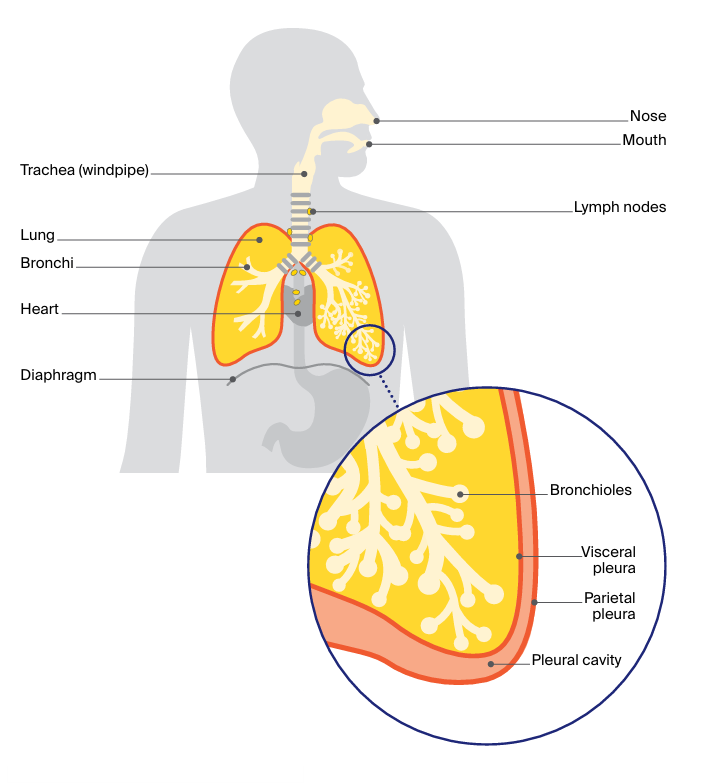
Pleural mesothelioma affects the pleura – the membrane that covers the lungs. The lungs are the main organs used for breathing. They are part of the respiratory system, along with the nose, mouth, windpipe (trachea), large airways (bronchi) and smaller airways (bronchioles). The lungs rest on the diaphragm – a wide, thin muscle that helps you to breathe.
The mesothelium (protective membrane) that covers the organs and lines the walls of the abdomen and pelvis is called the peritoneum. Mesothelioma that develops in the peritoneum is known as peritoneal mesothelioma. It is far less common than pleural mesothelioma (which is found around the lungs), and accounts for less than 5% of all mesotheliomas.
There are 2 layers of thin tissue in the peritoneum. The inner layer (the visceral peritoneum) lines the surface of organs such as the bowel, liver and ovaries. The outer layer (the parietal peritoneum) lines the walls of the abdomen and pelvis.
Between the 2 layers of the peritoneum is the peritoneal cavity, which normally contains a very thin film of fluid. This fluid allows the 2 layers to slide over each other. In people with peritoneal mesothelioma, too much fluid often collects between the 2 layers in this cavity. This is called ascites or peritoneal effusion.
Peritoneal mesothelioma affects the peritoneum – the membrane that lines the walls and covers the organs of the abdomen and pelvis. These organs include the stomach, bowel, liver, kidneys and, in females, the uterus and ovaries.
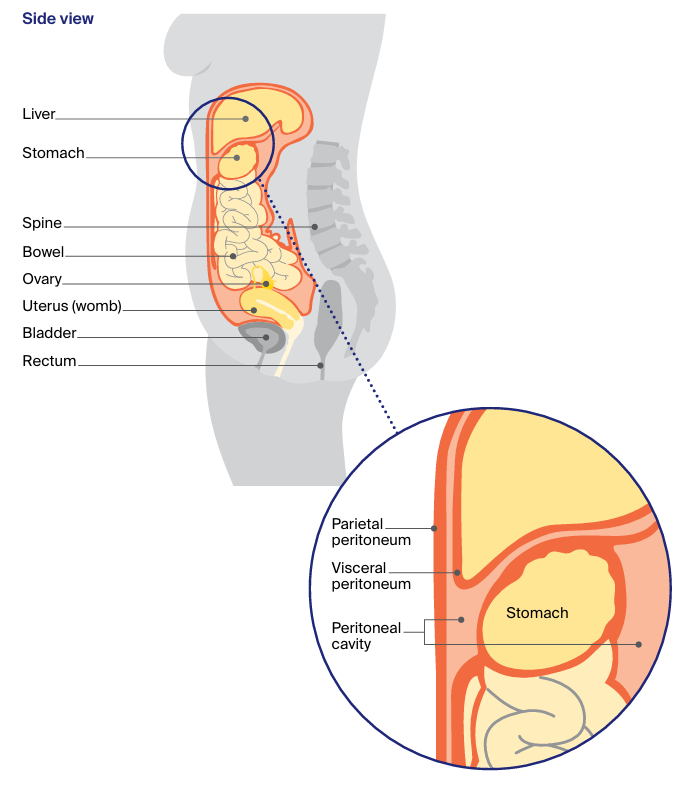
Peritoneal mesothelioma affects the peritoneum – the membrane that lines the walls and covers the organs of the abdomen and pelvis. These organs include the stomach, bowel, liver, kidneys and, in females, the uterus and ovaries.
In rare cases, mesothelioma can develop in the pericardium, which is a thin, double-layered sac that surrounds the heart. This is called pericardial mesothelioma.
Even more rarely, mesothelioma can occur in the membrane that surrounds the testicles, known as the tunica vaginalis. This is called testicular mesothelioma.
For more information, see Rare and less common cancers.
Australia has one of the highest rates of mesothelioma in the world, with about 800 Australians diagnosed each year.3 Men make up the majority of cases, with less than a quarter of people diagnosed with mesothelioma being women. This is possibly because asbestos exposure is more common in jobs that were traditionally done by men, such as mining and construction.
Pleural mesothelioma makes up about 92% of cases; peritoneal mesothelioma makes up less than 5% of cases; and other types are even more rare. Mesothelioma is more commonly diagnosed in people aged over 65, but can occur in younger people.
The plan for what happens if you have mesothelioma can vary from person to person, but is usually as follows:
Your GP will arrange the first tests to assess your symptoms. If these tests do not rule out mesothelioma, you will usually be referred to a specialist, such as a respiratory physician or gastroenterologist. The specialist will arrange further tests.
If mesothelioma is diagnosed, the specialist will consider the treatment options. Often these will be discussed with other health professionals at what is known as a multidisciplinary team (MDT) meeting. During and after treatment, you will see a range of health professionals who specialise in different aspects of your care.
Lung Foundation Australia
Services offered
Rare Cancers Australia
Services offered
Find the right services for your needs, wherever you are in Australia
Trusted cancer information for all people affected by cancer
We're available 9am - 5pm, Monday to Friday (excluding public holidays)