
Overview
Copy needed.
What's on this page

Types of strength and resistance exercises (JK)
Strength and resistance training uses weights or resistance to increase the size, strength and endurance of your muscles, and to strengthen bones. Aim to do this activity at least 2 times a week (see how much exercise and training you should do).
The weights or resistance that can be used include:
- your own body weight – you use body weight for push-ups, pull-ups from the floor or against a wall, and squats, yoga and mat-work Pilates
- free weights – this includes dumbbells and barbells, hand weights and weighted bags which you hold, along with wrist and ankle weights which you attach with straps
- weights or resistance machines – these are devices that have adjustable seats or handles attached to either weights or hydraulics, weight stacks, levers and pulleys to provide resistance
- elastic resistance bands – sometimes called TheraBands or stretchbands, they are like giant rubber bands that are hard to stretch; they come in different colours according to the level of resistance.
An exercise professional can suggest what weights or bands you should use. You can buy free weights and resistance bands at sporting goods stores, some major retailers or online. Hand weights can be made from tin cans or plastic bottles filled with water or sand. Use scales to check the weights are of equal value. Use a backpack that has a handle to hold, and vary the resistance by adding bags of sand or water bottles.
This section includes simple strength and resistance exercises to try with an exercise professional or at home.
How much training should I do?
Try to do strength and resistance training 2 or more times a week (find out about activity guidelines). Have a rest day in between.
Strength and resistance training exercise sessions include several different parts:
- repetition (reps) – doing an exercise from the start position, through the movement, and back to the start (e.g. 10 squats is 10 reps)
- set – a series of repetitions (e.g. doing 10 squats, 2 times, is 2 sets)
- rest – the time between each set.
During each training session, aim for 6–10 exercises that target the major muscle groups of the arms, legs and torso.
An exercise professional can design a program, or as a guide, you can try:
- 6–10 different types of exercises (shown below)
- 4–10, 6–12 or 8–12 repetitions of each exercise per set
- 1–4 sets of each exercise per session
- 1–2 minutes of rest between sets.
A program should challenge your muscles without straining them. This is a good way to decide how many repetitions you do in a set when you first start exercising.
To help work out the repetitions or amount of resistance, aim to feel like you have 2–3 repetitions left at the end of a set. If you feel like you could do another 8–10 repetitions, then the resistance is too low. Once you become comfortable with a program, you can increase your strength by making it harder – but just make small increases at a time.
You may feel some soreness after exercising. This is normal at the end of a set, or 1 or 2 days after you have exercised. But any soreness should not be excessive. If you are quite sore or the pain continues for more than 2 days, then the session or resistance was too hard.
Standing wall push-up
Muscle groups: Chest and shoulders
- Stand with your feet shoulder width apart. Lean slightly against the wall with your arms outstretched at shoulder height and your hands on the wall. Do not lock your elbows or knees.
- Slowly move your body towards the wall, by bending your arms at the elbow. Keep your feet where they are.
- Once your nose is close to the wall, breathe out as you slowly push away, against your body weight, and return to the starting position. Repeat.
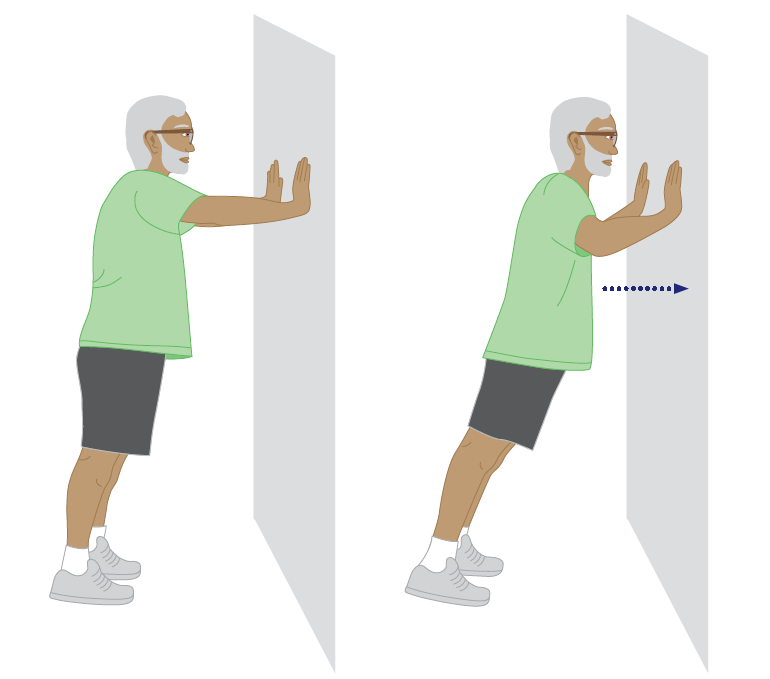
If this is too easy, move your feet back a bit or try a modified knee push-up (see below).
Find support services
Find the right services for your needs, wherever you are in Australia
Read cancer information
Trusted cancer information for all people affected by cancer
Need to talk to someone?
We're available 9am - 5pm, Monday to Friday (excluding public holidays)