
Overview
Flexibility exercises, or stretches, help keep your muscles and joints flexible and can reduce stiffness. Cancer treatment and getting older can make it harder to move as freely, so regular stretching may help.
Aim to do flexibility exercises at least three times a week, focusing on your arms, legs and torso. Stretch slowly and gently, keep breathing normally, and stop if you feel pain.
Balance exercises can help you feel steadier, particularly if cancer or its treatment has affected your strength or stability.
What’s on this page

Flexibility exercises
Flexibility exercises, also known as stretches or range-of-motion (ROM) exercises, lengthen muscles and tendons. They improve or maintain the flexibility of joints and muscles. We naturally lose joint and muscle flexibility as we age, but cancer treatments also contribute to this. Regular stretching helps to improve stiffness and flexibility.
This section has simple flexibility exercises you can do at home. You could also join a class that focuses on stretching, like an easy yoga class. Check with your health professional that these exercises are safe for you.
See Cancer Council's Arm and shoulder exercises if you have recently had breast cancer surgery and want to start movement and exercise.
How much exercise should I do?
Try to do flexibility exercises 3 or more times a week. They can be done the same day as other exercise, or on their own. Include stretches for arms, legs and torso (core). In each session, you might do 1–3 sets of 4–6 different stretches. Any stretching is better than none.
Tips for stretching
- You can warm up your muscles first with some aerobic exercise.
- After aerobic exercise, aim to stretch during the cool-down phase.
- Keep breathing normally. Do not hold your breath.
- Maintain good posture, and stretch slowly and steadily. Do not bounce.
- Stretch to the point of mild discomfort, but never keep pushing the stretch if it hurts.
Flexibility exercises to try
Shoulder stretch
Muscle group: Shoulders
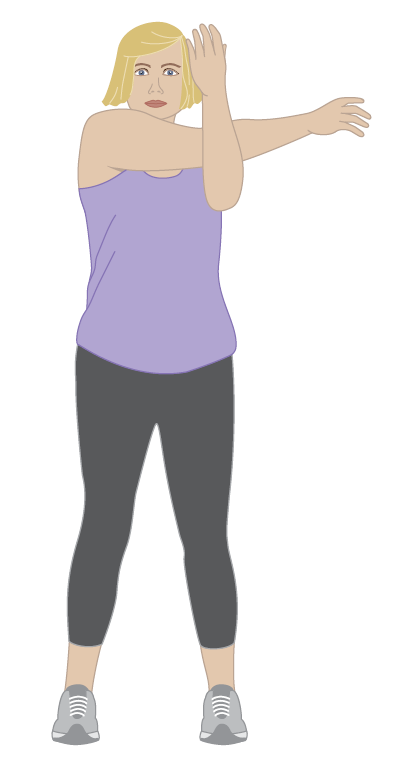
- Stand with your feet about hip width apart and arms relaxed by your sides.
- Raise one arm to shoulder height and slowly and gently pull it across your chest and wrap your other arm underneath to support it. Do not stretch more than feels comfortable. Keep the elbow of your straight arm just below shoulder level.
- Hold for 15–30 seconds, before returning to the starting position. Switch arms and repeat.
Keep the shoulder that is being stretched relaxed and try to avoid it moving up towards your ear. If this starts to happen, you may be stretching too far.
Triceps stretch
Muscle group: Back of arms
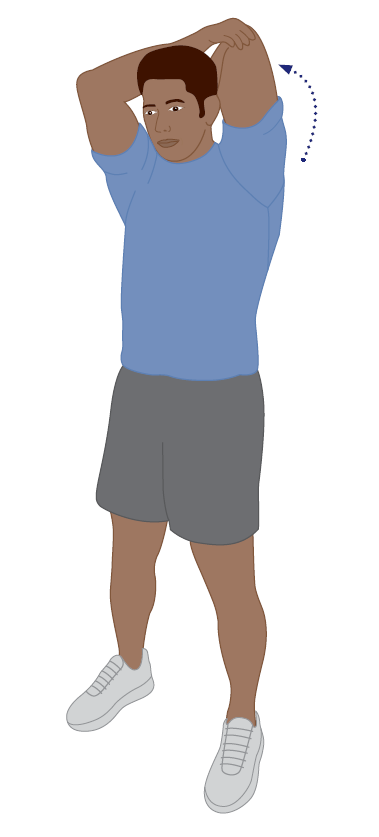
- Stand with your feet about hip width apart and arms relaxed by your sides.
- Lift one arm to shoulder height and bend your elbow with your forearm down your back.
- Using the elbow as a lever, use your other arm to gently push the arm down your back. Hold for 15–30 seconds.
- Return to the starting position. Switch arms and repeat.
Try not to bend your head forward too far and keep the stretched arm close to your ear.
Pectoral and biceps stretch
Muscle groups: Chest, forearm and upper arms
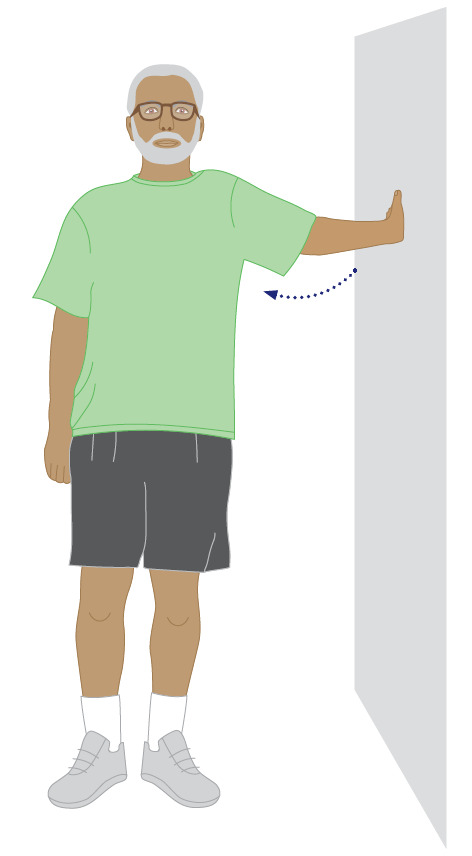
- Stand near a wall. Raise one arm out to the side so it is parallel to the floor, and put your hand against the wall with your fingers pointing away from you.
- Partially turn your body away from the wall and arm that is against the wall. Hold the stretch for 15–30 seconds.
- Return to the starting position. Switch arms and repeat.
Quadriceps stretch
Muscle group: Front of thighs
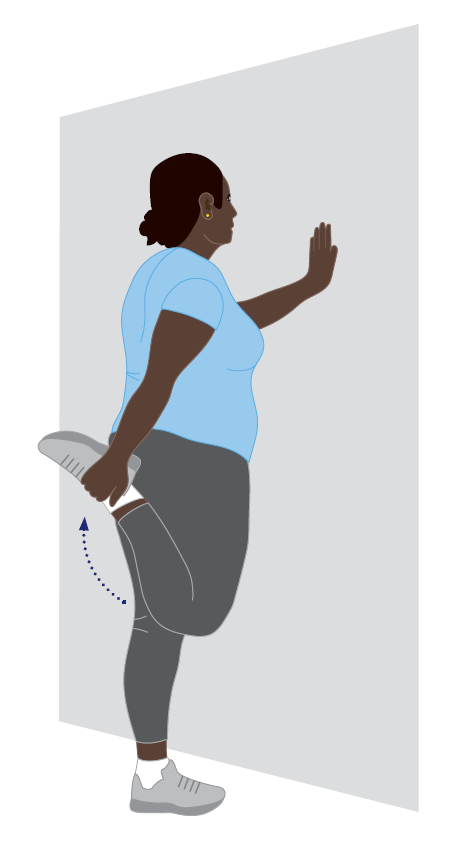
- Stand near a wall to use as a support.
- Lift your foot behind you and hold in front of the ankle. Gently pull the leg towards your buttocks. Make sure you keep your torso straight. Hold for 15–30 seconds.
- Return to the starting position. Switch legs and repeat.
You can wrap a towel around your ankle to hold if you can’t reach your ankle easily.
Calf stretch
Muscle group: Calves
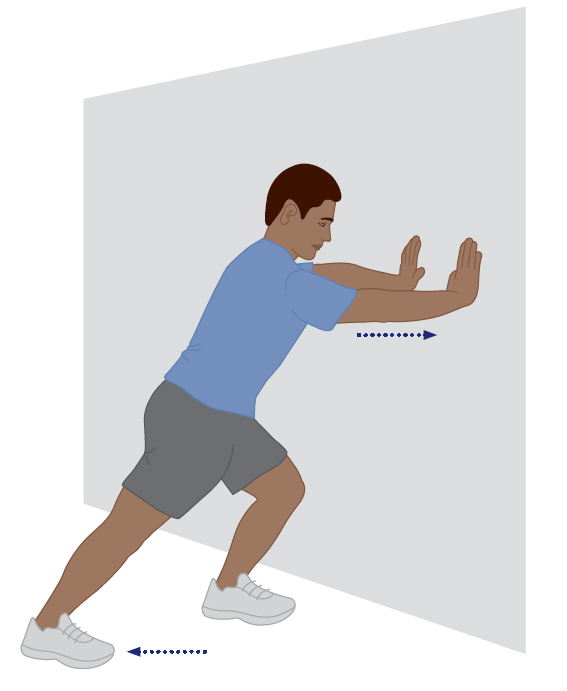
- Stand facing a wall with your arms straight and hands flat against the wall. Step one of your feet straight back, placing the heel flat on the floor.
- Lean forward against the wall and partially bend your front leg. Keep your back leg (stretching leg) completely extended and your foot flat on the floor – move the foot backwards until you feel the stretch. Hold for 15–30 seconds.
- Switch legs and repeat.
Hamstrings stretch
Muscle group: Back of thighs
Equipment: Chair
- Sit one on a chair with leg bent at the knee and the other leg straight, toes pointing upwards.
- Lean forward from the hips, pushing your chest forward towards your knee. Keep your back straight. Hold for 15–30 seconds.
- Switch legs and repeat.
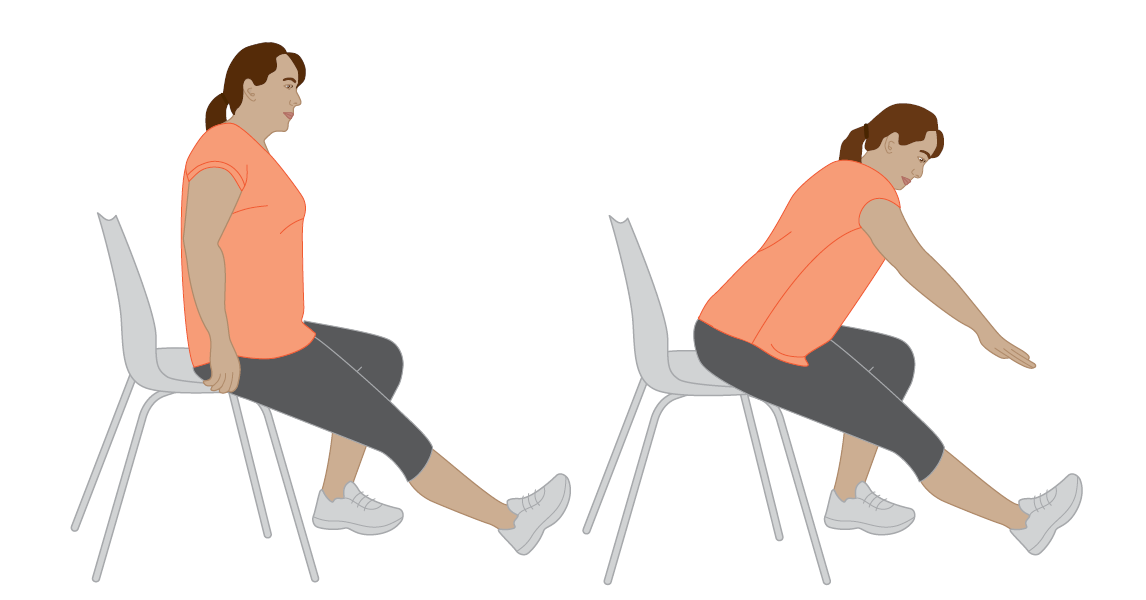
For more of a stretch, stand and put one foot on a step (about 30 cm high), toes pointing up. You may want to do this near a wall in case you need to steady yourself.
Balance exercises
Balance exercises are designed to help you to be stable while standing, walking or doing other activity. They may be important if you have been inactive for some time – like when you’ve been in hospital or in bed for a while. Balance exercises can help people with certain types of cancer that affect their stability, such as brain or other head cancers, or that affect a leg or leg strength. People with peripheral neuropathy or weak bones may also find balance exercises helpful.
Some balance exercises are simple and can be done by yourself, others may need someone to help you. You could also use a wall or a stable chair to provide support if needed. If you have a balance issue, a health professional can design a program for you. Take care when beginning and have someone with you if you are not doing exercises with an exercise physiologist or physiotherapist.
One-leg balance
Muscle groups: Legs, stomach, side and back
Equipment: Chair (optional)
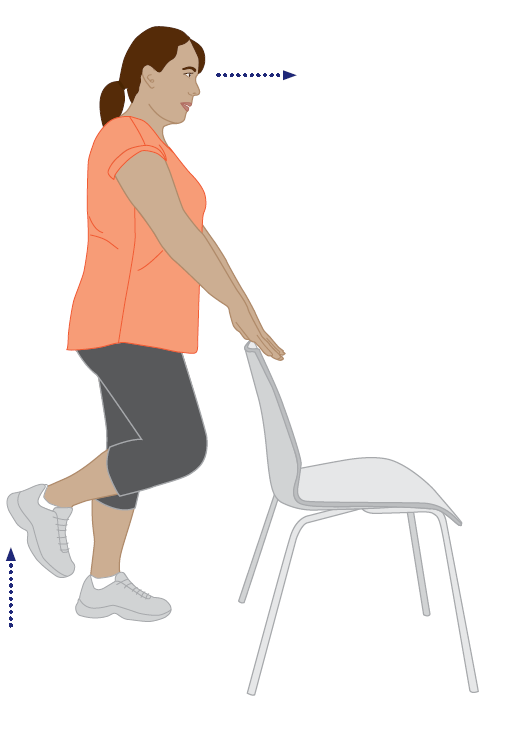
- Stand on a soft but firm surface, such as an exercise mat or carpet.
- Slowly bend one knee to lift the foot off the ground so that you are balancing on the other leg. Keep your eyes on a fixed point in front of you and breathe slowly and deeply. Hold the pose for several seconds if you can.
- Lower your leg and put your foot back on the ground. Switch to the other leg and repeat.
- You may want to start near a chair or wall so you can steady yourself.
- For a challenge, put your hands on your head as you balance and/or close your eyes. Aim to increase the duration by a few seconds each week.
Other simple balance exercises
One-leg lift
- Stand with feet hip distance apart.
- Lift your arms to shoulder height and extend them out to the sides.
- Lift your left foot off the floor and bend your knee to bring your heel towards your bottom.
- Hold for up to 30 seconds. Repeat on the opposite side.
- Do each side 3 times.
Tightrope walk
- Use a line in floorboards or tiles, a line of tape or any straight line.
- Like walking a tightrope, extend your arms out to the sides and walk slowly, being careful to keep your feet on the line at all times.
- Walk from heel to toe, counting at least 5 seconds before each step, until you reach the end.
Find support services
Find the right services for your needs, wherever you are in Australia
Read cancer information
Trusted cancer information for all people affected by cancer
Need to talk to someone?
We're available 9am - 5pm, Monday to Friday (excluding public holidays)