

Australian Thyroid Foundation
Services offered
Cancer information
The thyroid makes hormones that control the body’s metabolism. Too little or too much thyroid hormone can affect how the body functions, causing symptoms such as tiredness and weight changes.
Each year, about 4300 people are diagnosed with thyroid cancer in Australia. There are several types of thyroid cancer. The most common is papillary thyroid cancer. Benign nodules (adenomas) can also develop. These are not cancer.
Learn more about types of thyroid cancer.
Thyroid cancer happens when abnormal cells grow uncontrollably, and form a lump or tumour. There are different types of thyroid cancer. Some grow slowly and others grow quickly. In rare cases, you can have more than one type of thyroid cancer at once. Benign thyroid nodules, also called adenomas, are not cancer.
About 4300 people are diagnosed with thyroid cancer each year in Australia, and rates are increasing. Women are more than twice as likely to develop thyroid cancer as men. Although it is the most common type of cancer that affects women aged 20–24, most of the people diagnosed with thyroid cancer are women in their 40s, 50s and 60s, and men in their 50s, 60s and 70s.
This butterfly-shaped gland sits at the front of the throat. The thyroid has 2 halves, called lobes. These 2 lobes sit on either side of the windpipe (trachea), just below the voice box (larynx). The lobes are connected by a small band of thyroid tissue called the isthmus. Behind the thyroid are 4 small glands called the parathyroid glands.
The thyroid and the parathyroid glands make hormones that are important for how your body works (see The thyroid hormones).
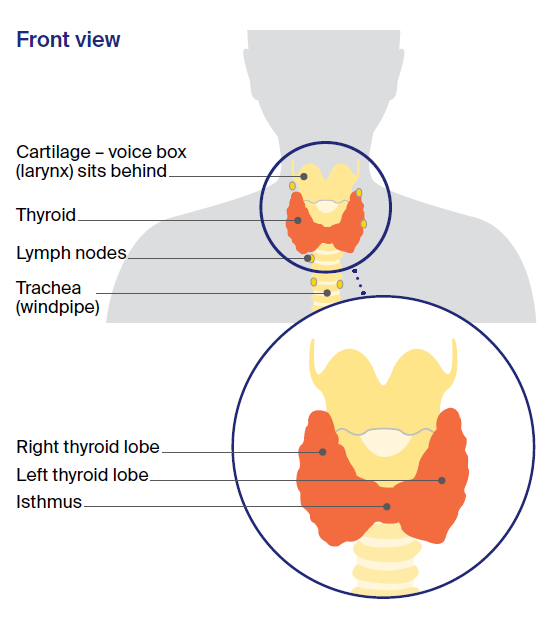
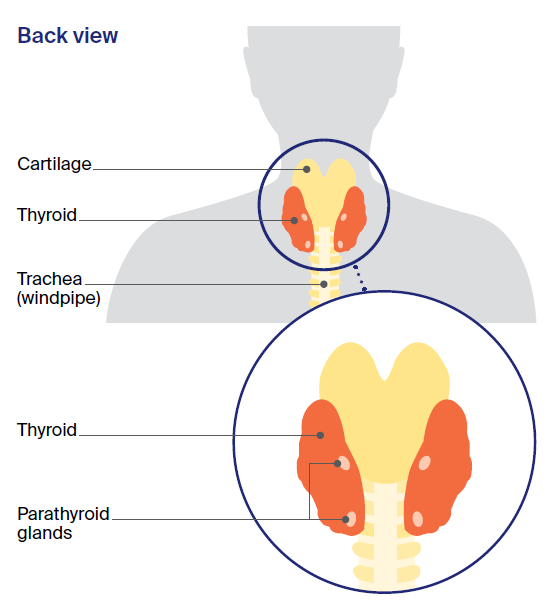
The thyroid has different types of cells that make hormones to control your metabolic rate, including your heart rate, how fast you digest food, your body temperature and weight. These hormones are called T4 and T3. Learn more about these and other thyroid hormones.
There are 2 main types of cells in the thyroid:
The 2 main hormones made in the thyroid are:
To keep the body’s metabolism working properly, it is important that the thyroid makes the right amounts of T4 and T3. This balance is controlled by a hormone called thyroid-stimulating hormone (TSH), which is made in the pituitary gland, near the brain.
If levels of T4 and T3 are low, the pituitary gland makes TSH, which tells the thyroid to make more hormones. If T4 and T3 levels are too high, the pituitary gland makes less TSH.
The thyroid gland and parathyroid glands also make the hormone calcitonin, which balances calcium levels in the blood.
Your doctor may talk to you about underactive and overactive thyroid symptoms, which are explained below:
Without enough thyroid hormone, your metabolism slows down.
You may:
In severe cases, heart problems could occur.
If you have too much thyroid hormone, your metabolism speeds up.
As a result, you may:
Over time, untreated hyperthyroidism can result in loss of bone strength and problems with heart rhythm and function.
Australian Thyroid Foundation
Services offered
Find the right services for your needs, wherever you are in Australia
Trusted cancer information for all people affected by cancer
We're available 9am - 5pm, Monday to Friday (excluding public holidays)