


Pancare Foundation
Services offered
Cancer information
Support from cancer nurses
Support from other health professionals
+4
Each year, about 2700 Australians are diagnosed with stomach cancer. The most common type of stomach cancer is called adenocarcinoma of the stomach, which starts in the stomach’s inner lining (mucosa).
Learn more below about the stomach and who treats stomach cancer.
Stomach cancer develops when cells in any part of the stomach grow and divide in an abnormal way. Tumours can begin anywhere in the stomach, although most start in the stomach’s inner lining (mucosa). This type of cancer is called adenocarcinoma of the stomach or gastric cancer.
Stomach cancer can spread to nearby lymph nodes or to other parts of the body, such as the liver and lungs. It may also spread to the lining of the abdomen (peritoneum).
About 2740 people are diagnosed with stomach cancer in Australia each year. Men are almost twice as likely as women to be diagnosed with stomach cancer. It is more common in people over 60, but it can occur at any age.
The stomach is a hollow, muscular organ, which is shaped like a pouch. It is part of the digestive system, which helps your body break down food and turn it into energy.
The top of the stomach connects to the end of the oesophagus (food pipe). The bottom of the stomach connects to the start of the small bowel.
When you eat, food goes into your stomach. The stomach uses its own digestive juices and muscle movements to break the food down into a thick liquid. This liquid moves into the small bowel, where nutrients are absorbed into your blood. The parts of the food your body does not need go into the large bowel and leave the body as waste known as faeces (also called stools or poo).
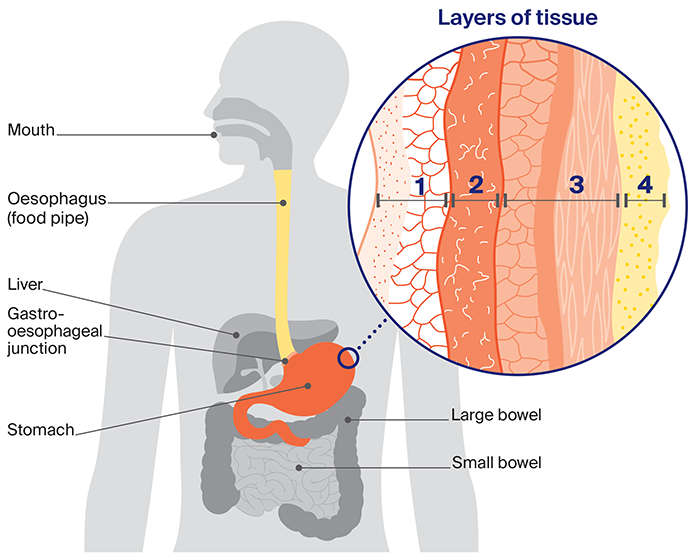
Other types of cancer can start in the stomach. These include small cell carcinomas, neuroendocrine tumours, lymphomas and gastrointestinal stromal tumours. These types of cancer aren’t discussed in this section and their treatment may be different. Call Cancer Connect on 13 11 20 for more information.
Pancare Foundation
Services offered
Find the right services for your needs, wherever you are in Australia
Trusted cancer information for all people affected by cancer
We're available 9am - 5pm, Monday to Friday (excluding public holidays)