

Australian Cancer Trials
Cancer Australia
Services offered
Information about clinical trials
Cancer cells can spread from a cancer in another part of the body to the bone through the bloodstream or lymph vessels. This is called secondary bone cancer.
Cancers that can spread to the bone include prostate, breast, lung, kidney and melanoma.
Secondary bone cancer may have symptoms including bone or back pain, fractures, fatigue and nausea.
Bone cancer can be either a primary or secondary cancer. Primary bone cancer means the cancer first started in the bone. It is a rare cancer.
Secondary bone cancer means that the cancer started in another part of the body, and has now spread (metastasised) to the bone. The 2 types of bone cancer are different, and this information is only about secondary bone cancer.
Secondary cancer in the bone, also called bone metastases or bone mets, often keeps the name of the original cancer. For example, breast cancer that has spread to the bone may be called secondary or metastatic breast cancer. Because the cancer has spread, it is considered advanced or stage 4 cancer. You may find it useful to read about the primary cancer type.
Cancer cells can spread from the original cancer (the primary cancer), through the bloodstream or lymph vessels, to any of the bones in the body. Bones commonly affected by secondary bone cancer include the spine, ribs, pelvis, and upper bones of the arms (humerus) and legs (femur).
Any type of cancer can spread to the bone. The cancers most likely to spread to the bone include:
Bones have a number of important functions. These include:
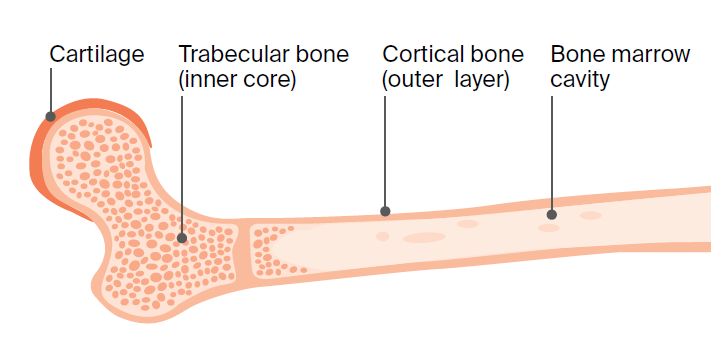
Bones are made up of different parts, including a hard, outer layer (known as cortical or compact bone) and a spongy inner core (known as trabecular or cancellous bone). Bone marrow – a substance containing fat and blood stem cells that can become red blood cells, white blood cells, or platelets – is found in this spongy core.
Normal bone is constantly going through a process called remodelling, or turnover, in which old bone is broken down and replaced with new bone.
Bones are made up of a hard outer layer, an inner core, and spongy bone marrow found in this inner core. Cartilage is the tough material at the end of each bone that allows one bone to move against another at a joint.
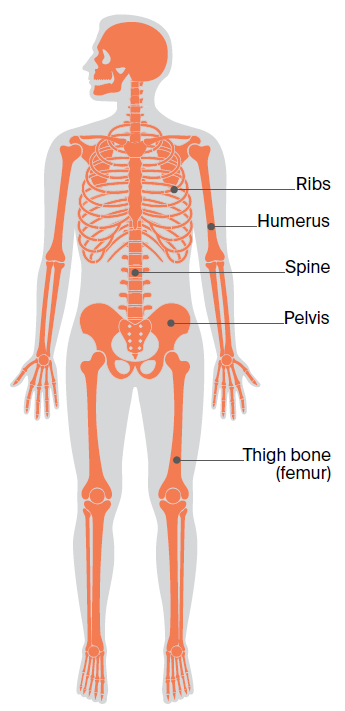
Cancer can spread to any bone in the body. Bones commonly affected include the spine, ribs, pelvis and upper bones of the arms and legs.
There are 2 main types of secondary bone cancer. Osteolytic is where bone is broken down by the cancer cells without being replaced by new bone. Holes, also called lytic lesions, might form in the bone, which increases the risk of a break or fracture.
Osteoblastic bone cancer is where new bone cells form abnormally in some areas. These areas are called osteoblastic (or sclerotic) lesions and even though they are very hard (dense), they make the bone weak and deformed.
Most people with secondary bone cancer develop either osteolytic or osteoblastic changes, but some have both.
Secondary bone cancer is much more common than primary bone cancer in Australia. It is more common in adults than children. The bone is one of the most common places cancer may spread to, along with the lymph nodes, liver, lungs and brain.
Secondary bone cancer is always caused by cancer cells that have spread to the bone from a primary cancer elsewhere in the body. It isn’t fully understood why some people develop secondary bone cancer and others don’t.
These are some signs and symptoms of secondary bone cancer. If you notice any of these symptoms, see your doctor.
Bone pain – This is often the first and most common symptom. The pain may be a dull, persistent ache. It can get worse with movement and is often worse at night.
Fractures – Cancer cells can weaken the bones and cause them to break more easily, often with little or no force (this is known as a pathological fracture).
High calcium levels in the blood (hypercalcaemia) – As the bone breaks down, calcium is released into the bloodstream. When calcium builds up in the blood, it may cause severe tiredness (fatigue), a feeling of sickness (nausea), vomiting, thirst, constipation or confusion.
Pressure on the nerves in the spine (spinal cord compression) – Abnormal bone growth or fractures can press on the nerves in the spine. This may cause back pain, muscle and limb weakness, tingling or numbness of the limbs, difficulty walking, or loss of bowel or bladder control.
Low levels of blood cells – Secondary bone cancer can affect the bone marrow, particularly if there is a large amount of spread to the bones. The bone marrow makes blood cells, so the cancer can lead to low levels of blood cells. Symptoms depend on the type of blood cells affected. You may feel tired and breathless, have an increased risk of infections, or bruise and bleed more easily.
We learn a lot more about our body and about life than a lot of people ever learn.
Australian Cancer Trials
Cancer Australia
Services offered
Palliative Care Australia
Services offered
Find the right services for your needs, wherever you are in Australia
Trusted cancer information for all people affected by cancer
We're available 9am - 5pm, Monday to Friday (excluding public holidays)