
Australian Cancer Trials
Cancer Australia
Services offered
Information about clinical trials
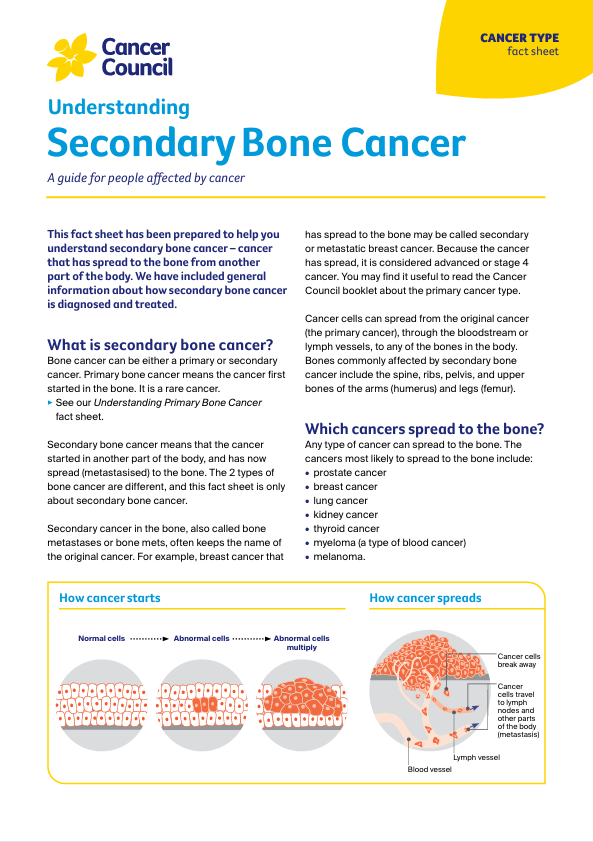
Secondary bone cancer means that the cancer started in another part of the body, and has now spread (metastasised) to the bone.
When cancer spreads to the bone (bone metastases or bone mets), it often keeps the name of the original cancer. For example, breast cancer that has spread to the bone may be called secondary or metastatic breast cancer.
We have separate information on cancer that starts in a bone. This is called primary bone cancer or bone sarcoma.
Finding out cancer has spread to the bone can be a shock. Find helpful information in Advanced cancer, or call Cancer Connect on 13 11 20 to talk it through with our qualified professionals.
Any cancer can spread to the bone, but the cancers most likely to spread to the bone include prostate, breast, lung and melanoma. Learn about different types of bone cancer.
Understand the symptoms of secondary bone cancer, including bone pain and fractures, and high levels of calcium in the blood.
Learn about how secondary bone cancer may be found. Doctors use blood tests, imaging scans or biopsies (taking a small sample for testing).
Treatment aims to control or shrink the cancer in the bone. Find out about radiation therapy, chemotherapy, targeted therapy, immunotherapy or hormone therapy.
Living with secondary bone cancer can be challenging. Discover ways to cope with emotions and manage common symptoms.
It can be a good idea to prepare a list of questions before your appointments. See our list of questions about secondary bone cancer.
Australian Cancer Trials
Cancer Australia
Services offered
Palliative Care Australia
Services offered
Find the right services for your needs, wherever you are in Australia
Trusted cancer information for all people affected by cancer
We're available 9am - 5pm, Monday to Friday (excluding public holidays)