


Myeloma Australia
Services offered
Cancer information
Support from cancer nurses
Emotional support
+3
Myeloma is a cancer of the plasma cells. These are the white blood cells made in the bone marrow, the spongy centre of the bone. Bone marrow is found throughout the body, so myeloma can affect multiple areas. This is why the disease is often called multiple myeloma.
Myeloma starts when the plasma cells become abnormal and multiply. They make an antibody called paraprotein which enters the bloodstream and there is less space for normal blood cells to develop and keep you healthy.
Myeloma is most common in people over 60 and is slightly more common in men than in women.
Myeloma is blood cancer of the plasma cells that are made in the bone marrow. Because bone marrow is found throughout the body, myeloma can affect multiple areas at the same time, and the disease is often called multiple myeloma.
Myeloma begins when abnormal plasma cells, known as myeloma cells, start multiplying. Normal plasma cells make different types of antibodies to help the body fight infections. Abnormal plasma cells make an antibody known as paraprotein, monoclonal protein or M-protein.
Paraprotein is usually found in the blood of people who have myeloma. However, low levels of paraprotein in the blood may also be a sign of smouldering myeloma.
Because myeloma cells crowd the bone marrow, there is less space for normal blood cells to develop and keep you healthy. As a result, a lack of:
Myeloma may also cause growths on the bones called lesions. These can weaken bones and lead to breaks (fractures). This is often how myeloma is first discovered.
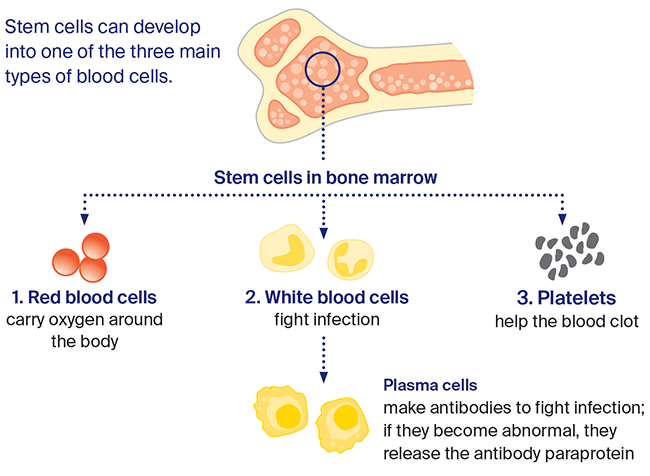
Bone marrow produces three main types of blood cells: red cells, white cells and platelets.
Plasma cells are a special type of white blood cell. Myeloma starts when plasma cells become abnormal and multiply, crowding the bone marrow. They usually release an antibody (paraprotein) into the blood.
Cancer is a disease of the cells. Cells are the body’s basic building blocks – they make up tissues and organs. The body constantly makes new cells to help us grow, replace worn-out tissue and heal injuries. Normally, cells multiply and die in an orderly way, so that each new cell replaces one lost. Sometimes cells become abnormal and keep growing. These abnormal cells may turn into cancer.
In solid cancers, such as breast cancer, the abnormal cells form a mass or lump called a tumour. However, myeloma is a blood cancer that starts in the bone marrow. Bone marrow is the spongy centre of the bone where blood cells are produced.
In myeloma, a type of white blood cell, called a plasma cell, changes and becomes abnormal. Healthy plasma cells make antibodies, called immunoglobulins, that protect us from infection.
Without treatment, the bone marrow keeps making more abnormal myeloma cells, leaving less room for normal healthy blood cells. This drop in healthy blood cells and antibodies weakens the immune system and can damage the kidneys. Myeloma can then spread to other parts of the body that contain bone marrow, such as the spine, skull, shoulders, ribs and pelvis.
Most myeloma cells produce an abnormal antibody called paraprotein, which enters the bloodstream. Levels of paraprotein usually build up in the blood, and may be detected on a blood test.
Blood is pumped around your body to provide oxygen and nutrients to your organs and tissues, and remove waste. It contains red blood cells, white blood cells and platelets – each with its own job to help the body function. All three types of blood cells live for a limited time and need to be continually replaced. Most are made in the bone marrow – the spongy centre of the bones. The bone marrow contains stem cells. These are unspecialised blood cells that develop into mature red or white blood cells or platelets. Once mature, blood cells are usually released into the bloodstream to carry out their jobs.
Myeloma and leukaemia are both types of blood cancer, but they affect the body in different ways. Leukaemia is cancer of the white blood cells, which can be detected on a specific blood test. Myeloma is cancer of the plasma cells, which are found in the bone marrow and not usually detected in the blood.
In rare cases, cancerous plasma cells form a tumour in the bone or tissue, called solitary or multiple solitary plasmacytoma. Unlike myeloma, solitary plasmacytoma produces few or no abnormal plasma cells in bone marrow. Because it is in one area, plasmacytoma is usually treated with radiation therapy. Some people later develop myeloma or another plasmacytoma.
In Australia, about 2700 people are diagnosed with myeloma each year. Myeloma accounts for almost 14% of blood cancers and less than 2% of all cancers. It is most common in people who are aged over 60. Myeloma can still affect younger people, but it is quite rare in people aged under 40. Myeloma is slightly more common in men than in women.
Your GP will arrange the first tests to assess your symptoms. If these tests do not rule out cancer, you will usually be referred to a specialist, such as a haematologist. In some regional areas, people may see a medical oncologist instead. The specialist will arrange further tests.
If myeloma is diagnosed, the specialist will consider treatment options (some myeloma may not need treatment). Often these will be discussed with other health professionals at what is known as a multidisciplinary team (MDT) meeting. During and after treatment, you will see a range of health professionals who specialise in different aspects of your care.
Myeloma Australia
Services offered
Leukaemia Foundation
Services offered
Find the right services for your needs, wherever you are in Australia
Trusted cancer information for all people affected by cancer
We're available 9am - 5pm, Monday to Friday (excluding public holidays)