

Lung Foundation Australia
Services offered
Cancer information
Support from cancer nurses
Emotional support
+1
For lung cancer, radiation therapy is usually delivered from a machine outside the body. It can be standard external beam radiation therapy (EBRT) or stereotactic radiation therapy, which targets a localised tumour with a very high dose of radiation.
Side effects of radiation therapy include fatigue, discomfort when swallowing and heartburn.
Also known as radiotherapy, radiation therapy uses radiation to target and kill cancer cells. This reduces the risk of the cancer growing or spreading. It uses advanced technology to focus the radiation on the cancer and avoid the normal parts of the body. You may be given radiation therapy on its own, or after surgery or chemotherapy, or at the same time as chemotherapy (called chemoradiation). When you have it depends on the stage of the cancer.
Radiation therapy may be recommended to treat the primary tumour in the lung:
You may be offered radiation therapy as palliative treatment, to control the primary tumour in the lung or areas where the tumour has spread to, with the aim of relieving pain, breathlessness or other symptoms.
For lung cancer, radiation is usually delivered in the form of x-ray beams from a machine outside the body called a linear accelerator. This is known as external beam radiation therapy (EBRT) and can be done as standard EBRT or stereotactic radiation therapy (see below).
This is usually given once a day, Monday to Friday; each daily treatment lasts for a few minutes. How many treatments you need will depend on the aim of the treatment. To control symptoms, it’s usually 1–2 weeks. Longer-term control is usually for 3–6 weeks.
Also called stereotactic body radiation therapy (SBRT) or stereotactic ablative body radiation (SABR), this can be given as a single dose or a number of doses. It targets a localised tumour with a very high dose of radiation. SBRT cannot be used safely if tumours are close to other organs, such as the windpipe.
External beam radiation uses a machine that gives high-dose radiation beams from different angles to precisely target the tumour.
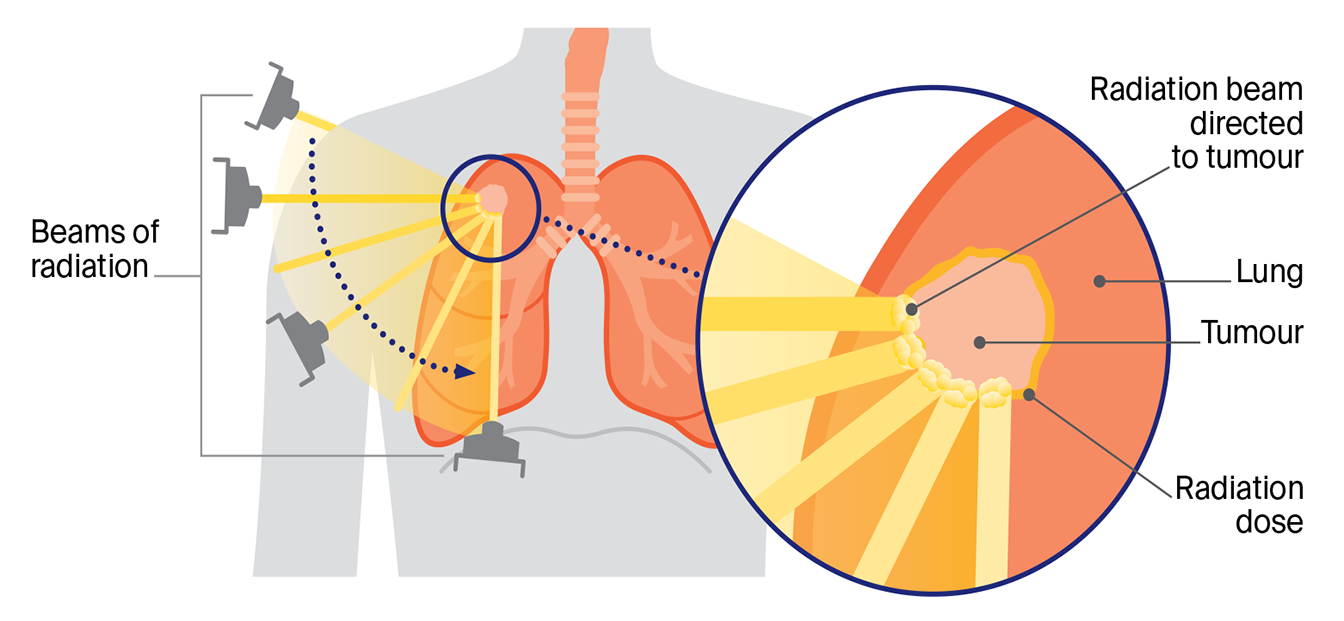
Before treatment starts, you will have a planning session at the radiation therapy centre to work out the dose and position of the beams. During this session, you will have a CT scan to determine the area to be treated, and small marks will be put on your skin so the radiation therapists ensure your body is in the same position for every treatment. You may have a 4-dimensional CT scan to record any movement of the cancer as you breathe. You may also be shown some breathing exercises to help your breathing stay as regular as possible.
Each treatment day, a radiation therapist will help you lie in the position decided at the planning session. You will have an x-ray to check that the correct area is being treated. When the treatment is being delivered, you will be alone in the room, but the radiation therapists will be able to hear you and talk to you from the monitoring area as there are speakers and a microphone in the room. The radiation treatment itself takes only a few minutes, but a session may last about 20 minutes, depending on how complex the set-up process is.
Radiation therapy itself is painless, but it can affect some tissues and organs of the body. You may experience some side effects during or after radiation therapy, depending on the dose, the number of treatments and the part of the chest treated. Most side effects are temporary and improve a few weeks after treatment.
Feeling tired is common after radiation therapy. You may need more rest or sleep, but gentle exercise and being physically active, if you are able to, is encouraged. See tips on managing fatigue.
If the cancer is in the centre of the chest and near the oesophagus, you may find swallowing uncomfortable, and develop heartburn. You may need to eat softer food and avoid hot drinks until you feel better. You may also be prescribed medicine by your radiation oncologist to control the pain until these side effects resolve.
Skin may become red and inflamed if the tumour is very close to the skin, but this is rare. Applying a moisturising cream and sun protection daily can help protect your skin.
Radiation therapy may cause inflammation of the lungs, called radiation pneumonitis. This may happen 2–12 months after the radiation has finished and usually doesn’t need any treatment. Occasionally, it can cause shortness of breath and/or a cough which may require treatment with steroids. Tell your radiation oncology team about any side effects you are concerned about, as most can be managed.
Lung Foundation Australia
Services offered
National Lung Cancer Screening Program
Australian Government
Services offered
Find the right services for your needs, wherever you are in Australia
Trusted cancer information for all people affected by cancer
We're available 9am - 5pm, Monday to Friday (excluding public holidays)