

Rare Cancers Australia
Services offered
Cancer information
Support from cancer nurses
Support from other health professionals
+6
The vulva is the general term for the female external sexual organs (genitals). When cells in any part of the vulva grow abnormally, vulvar cancer develops. It’s also known as vulval cancer or cancer of the vulva.
Vulvar cancer is rare. It is more likely to affect women whose periods have stopped (menopause) but it can develop in anyone who has a vulva at any age.
The most common type of vulvar cancer is squamous cell carcinoma (SCC), which starts in the flat skin cells covering the surface of the vulva. Vulvar (mucosal) melanoma starts in the skin cells lining the vulva and is much rarer.
Vulvar cancer is the abnormal growth of cells in any part of the vulva. It is also called vulval cancer or cancer of the vulva.
It most commonly develops in the skin of the labia majora, labia minora and the perineum. Less often, it involves the clitoris, mons pubis or Bartholin glands. As the cancer grows, it can spread to areas near the vulva, such as the vagina, bladder or anus.
Normally, cells multiply and die in an orderly way, so that each new cell replaces one lost. Sometimes cells become abnormal and keep growing. These abnormal cells may form a lump called a tumour. If the cells in a tumour are cancerous, they can spread through the bloodstream or lymph vessels and form another tumour at a new site. This new tumour is known as secondary cancer or metastasis.
The vulva is a general term for a female’s external sexual organs (genitals). The main parts of the vulva are shown in the diagram below.
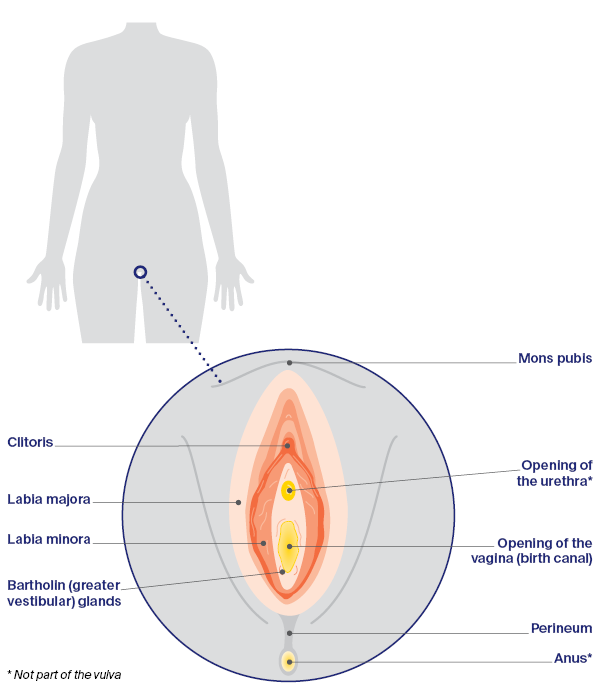
Clitoris – external part of an organ made of sensitive tissue that can create feelings of pleasure when stimulated; helps reach a sexual climax (orgasm)
Labia majora – outer lips of the vulva
Labia minora – inner lips of the vulva
Bartholin (greater vestibular) glands – produce mucus to lubricate the vagina
Mons pubis – area of fatty tissue covered with pubic hair
Opening of the urethra* – carries urine from the bladder to the outside of the body
Perineum – area of skin between the vulva and anus
Anus* – opening at the end of the bowel, where solid waste matter leaves the body
The types of vulvar cancer are named after the cells they start in.
There are also rarer types of vulvar cancer. These include sarcomas, adenocarcinomas, Paget disease of the vulva, and basal cell carcinomas (BCCs).
Vulvar cancer is rare – about 420 women are diagnosed each year in Australia. It is more likely to affect women who have gone through menopause (stopped having periods), but it can occur at any age.
Anyone with a vulva can get vulvar cancer – women, transgender men, non-binary people and intersex people. For more information, speak to your doctor or see LGBTIQA+ people and cancer.
Sometimes the squamous cells in the vulva start to change. These changes may be precancerous. This means there is an area of abnormal tissue (a lesion) in the vulva that is not cancer, but may develop into cancer over time if left untreated.
These lesions are called vulvar squamous intraepithelial lesions (SIL). They can be classified as:
Most cases of vulvar SIL don’t develop into vulvar cancer. Your doctor will explain the treatment options suitable for you.
Rare Cancers Australia
Services offered
Find the right services for your needs, wherever you are in Australia
Trusted cancer information for all people affected by cancer
We're available 9am - 5pm, Monday to Friday (excluding public holidays)