
Overview
Each year, about 1000 people are diagnosed with testicular cancer in Australia.
The testicles (also called testes) make and store sperm. They are 2 small egg-shaped glands inside the scrotum.
Learn more about the main types of testicular cancer and who treats testicular cancer below.
What’s on this page

What is testicular cancer?
Cancer that starts in the cells of a testicle is called testicular cancer or cancer of the testis (which means one testicle). Usually, it affects only one testicle, but sometimes both are affected.
As testicular cancer grows, it can spread to lymph nodes in the abdomen (belly) or to other parts of the body, such as other lymph nodes, lungs or liver. It does not spread to the other testicle.
How common is it?
Testicular cancer is not common overall, but it is the most common cancer diagnosed in men aged 20–39 (apart from skin cancers). About 1026 people in Australia are diagnosed with testicular cancer each year, which is about 1% of all cancers in men. Anyone with a testicle can get testicular cancer, including men, transgender women, non-binary people and people with intersex variations.
The testes
The testicles (also called testes) are part of the male reproductive system, which also includes the penis and prostate (see diagram below). They are 2 small egg-shaped glands that sit in the scrotum.
The testicles make and store sperm. They also make the hormone testosterone, which is responsible for the development of male characteristics, such as facial hair, a deeper voice and sex drive (libido).
The male reproductive system
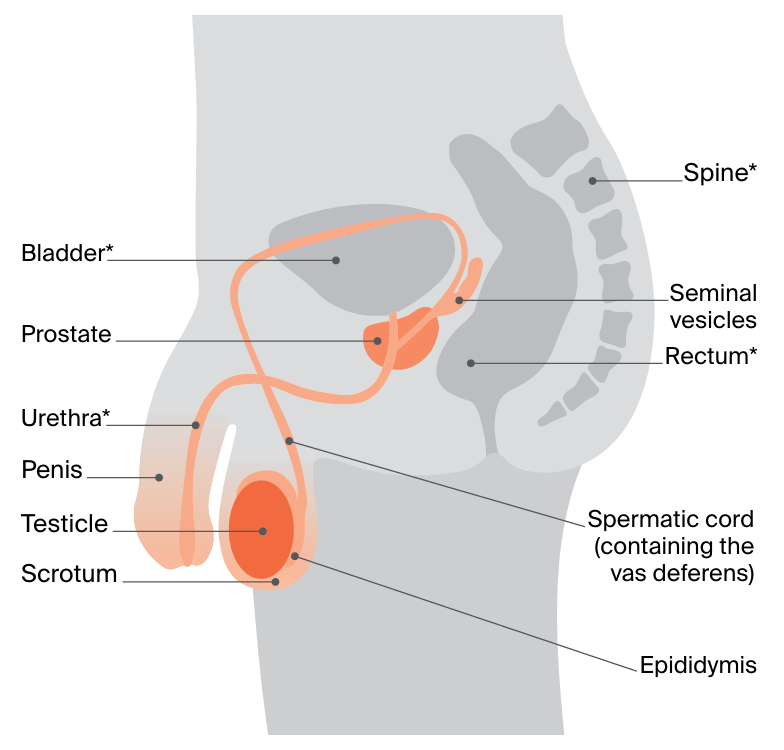
- Epididymis – a tube behind each testicle that stores immature sperm
- Spermatic cord – contains blood vessels, nerves, lymph vessels and the vas deferens
- Vas deferens – a long tube that carries mature sperm to the urethra to prepare for ejaculation
- Scrotum – a pouch of skin that holds the testicles
- Seminal vesicles – glands that produce fluid that carries sperm
- Prostate – a gland that produces fluid that helps nourish and protect sperm
- Urethra* – a tube that runs from the bladder and through the prostate to take urine (pee) out of the body
*Not part of the reproductive system
Types of testicular cancer
The most common testicular cancers are called germ cell tumours. There are 2 main types, seminoma and non-seminoma.
Germ cell tumours
Seminoma
- tends to develop more slowly than non-seminoma cancers
- usually occurs between the ages of 25 and 45, but can occur at older ages
- tends to develop more quickly than seminoma cancers
Non-seminoma
- more common in late teens and early 20s
- there are 4 main subtypes: teratoma, choriocarcinoma, yolk sac tumour and embryonal carcinoma
A testicular tumour can also include a mix of seminoma and non-seminoma cells, or a combination of the different types of non-seminoma cells. This is called a mixed germ cell tumour and is treated the same as non-seminoma cancer.
A small number of testicular tumours start in cells that make up the supportive (structural) and hormone-producing tissue of the testicles. These are called stromal tumours. The 2 main types are Sertoli cell tumours and Leydig cell tumours. They are usually benign (not cancer) and are removed by surgery.
What is germ cell neoplasia in situ (GCNIS)?
Most testicular cancers begin as a condition called germ cell neoplasia in situ (GCNIS). In GCNIS, the cells are abnormal, but they haven’t spread outside the area where the sperm cells develop. GCNIS is not cancer, but it may develop into cancer.
GCNIS has similar risk factors to testicular cancer and is hard to diagnose because there are no symptoms. It can only be diagnosed by testing a tissue sample. Some GCNIS cases will be carefully monitored (this is called active surveillance), while other cases will be treated with radiation therapy or surgery to remove the testicle.
Find support services
Find the right services for your needs, wherever you are in Australia
Read cancer information
Trusted cancer information for all people affected by cancer
Need to talk to someone?
We're available 9am - 5pm, Monday to Friday (excluding public holidays)