

Rare Cancers Australia
Services offered
Cancer information
Support from cancer nurses
Support from other health professionals
+6
Soft tissue sarcomas are cancers that start in areas that connect, support and protect the body, such as muscles, tendons, blood vessels and deep skin tissue. They can be found anywhere but are more common in areas such as the head and neck, intestines, arm, shoulder and thigh.
Soft tissue sarcomas are rare cancers and are more common in people over 55. There are many different types and most are named after the cell where they first started or the part of the body where they are found.
The most common ones include angiosarcoma, from blood and lymph vessels; Kaposi sarcoma, from skin cells; and liposarcoma, from fat cells.
Cancer happens when cells become abnormal and keep growing. Soft tissue sarcomas are a group of cancers. They start in areas that support, connect, surround and protect the body. This includes fat, muscles, tendons and ligaments, lymph vessels, blood vessels, nerves and deep skin tissue.
Soft tissue sarcomas often form a painless lump. The lump may become painful if it grows. But most lumps in the body are not cancer.
Soft tissue sarcomas can grow into nearby tissue or spread (metastasise) to other parts of the body.
Sarcoma that starts in the bones, also called primary bone cancer or Ewing sarcoma, may be diagnosed and treated differently to other soft tissue sarcomas.
See Primary bone cancer for information about this type of sarcoma.
Soft tissue sarcomas are rare cancers. There are about 2,500 Australians diagnosed with a sarcoma each year, but this number is increasing.
Soft tissue sarcomas are more common in people over 55, but they can develop at any age.
For information about being diagnosed and coping with a rare type of cancer, see Rare and less common cancers.
Soft tissue sarcoma can grow almost anywhere, but it’s more common in the areas shown below.
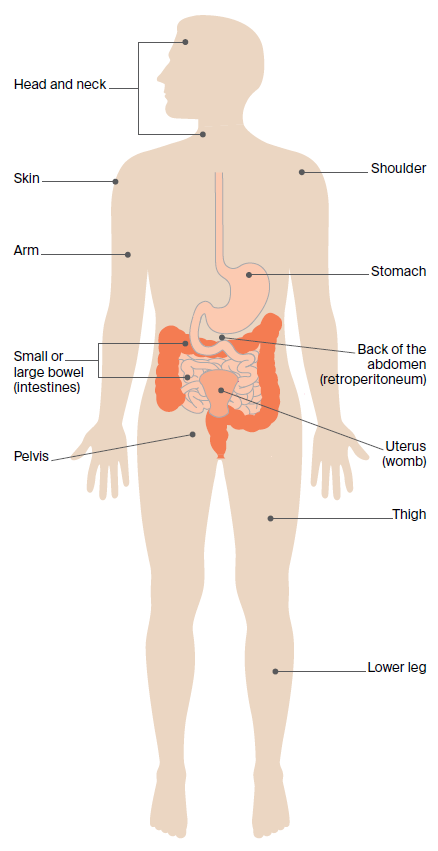
There are many different soft tissue sarcomas. The more common ones are listed here. Sarcomas are usually named after the type of cell where the cancer started, or the part of the body where they are found.
For more information about the different types of soft tissue sarcoma, visit the Australia and New Zealand Sarcoma Association (ANZSA) and Rare Cancers Australia.
Children or teenagers can also get sarcoma. This section focuses on adults, because care for young people may be different. For support for young people, visit:
Rare Cancers Australia
Services offered
Find the right services for your needs, wherever you are in Australia
Trusted cancer information for all people affected by cancer
We're available 9am - 5pm, Monday to Friday (excluding public holidays)