


Pancare Foundation
Services offered
Cancer information
Support from cancer nurses
Support from other health professionals
+4
Oesophageal cancer starts in the tube that connects the throat to the stomach. About 1700 people are diagnosed with oesophageal cancer each year, with men three times more likely that women to be diagnosed. The most common type is oesophageal adenocarcinoma.
Learn more below about types of oesophageal cancer.
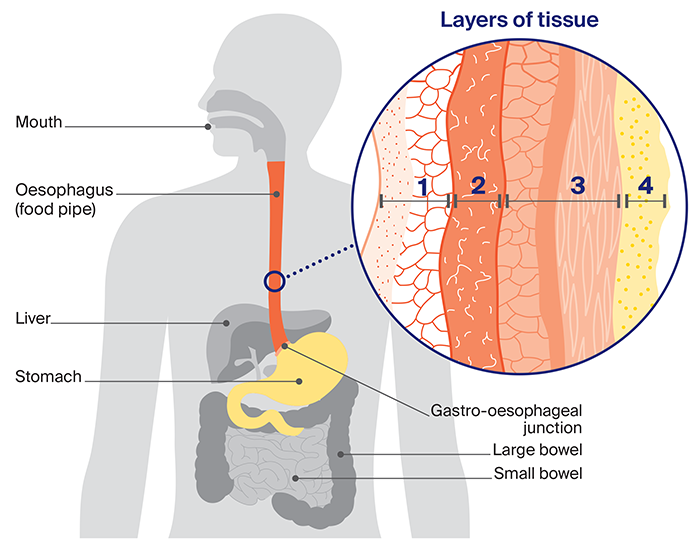
Oesophageal cancer begins when abnormal cells develop in the innermost layer of the oesophagus, called the mucosa. A tumour can start anywhere along the oesophagus. There are 2 main types:
Oesophageal adenocarcinoma – This type often starts near the gastro-oesophageal junction and is linked with Barretts oesophagus. Adenocarcinomas are the most common form of oesophageal cancer in Australia.
Oesophageal squamous cell carcinoma – This type starts in the thin, flat cells of the mucosa, which are called squamous cells. It often begins in the middle and upper part of the oesophagus.
Another type is gastro-oesophageal junction cancer. This starts where the oesophagus meets the stomach. It is usually treated like oesophageal cancer, but sometimes like stomach cancer.
If not found and treated early, oesophageal cancer can spread to nearby lymph nodes or to other parts of the body (e.g. liver and lungs). It can also grow through the oesophageal wall and into nearby organs.
The oesophagus (the food pipe) is a muscular tube that connects the throat to the stomach. In adults, it is about 25 cm long and lies behind the windpipe, which is used for breathing.
The oesophagus is part of the upper gastrointestinal (GI) tract, which is a section of the digestive system. It takes food and liquids (including saliva) from the mouth to the stomach. A valve (sphincter) at the lower end of the oesophagus stops acid and food moving from the stomach back into the oesophagus.
In Australia, about 1785 people are diagnosed with oesophageal cancer each year. Men are almost 3 times more likely than women to be diagnosed with this cancer. It is more common in people over 60, but it can occur at any age.
Pancare Foundation
Services offered
Find the right services for your needs, wherever you are in Australia
Trusted cancer information for all people affected by cancer
We're available 9am - 5pm, Monday to Friday (excluding public holidays)