

Head and Neck Cancer Australia
Services offered
Cancer information
Support from cancer nurses
Emotional support
+1
Radiation therapy uses carefully targeted radiation to destroy cancer cells. It is usually given as external beam radiation therapy (EBRT).
You may receive radiation therapy on its own, after surgery, or in combination with chemotherapy (chemoradiation).
Side effects of radiation therapy may be short-term or ongoing and can include fatigue, dry mouth and changes to your taste or appetite.
This treatment (also called radiotherapy) uses a controlled dose of radiation to kill or damage cancer cells. For head and neck cancer, it is most often given with external beam radiation therapy (EBRT). A technique called intensity modulated radiation therapy (IMRT) targets the radiation precisely to the cancer, which reduces treatment time and causes as little harm as possible to nearby healthy tissue.
For some pharyngeal and laryngeal cancers, radiation therapy will be the main treatment. The aim is to destroy the cancer while maintaining normal speech, swallowing and breathing. Sometimes chemotherapy will also be used to help the radiation work better (chemoradiation). Radiation treatment usually is given daily for 7 weeks for most head and neck cancers, but this may vary from person to person.
Radiation therapy is often used after surgery for head and neck cancers. This is known as adjuvant treatment. The aim is to destroy any remaining cancer cells and reduce the chance of the cancer coming back. You will probably start radiation therapy as soon as your wounds have healed and you’ve recovered your strength, which should be within 6 weeks. Adjuvant radiation therapy is sometimes given together with chemotherapy (chemoradiation). This is usually given for about 6–7 weeks, but may vary person to person.
Before radiation therapy, you meet with a radiation oncologist to work out whether radiation therapy is right for you. You will have a planning session with a CT scan to show the exact area that needs the radiation. You will also be fitted for a plastic mask called an immobilisation mask. You will wear this at each treatment session.
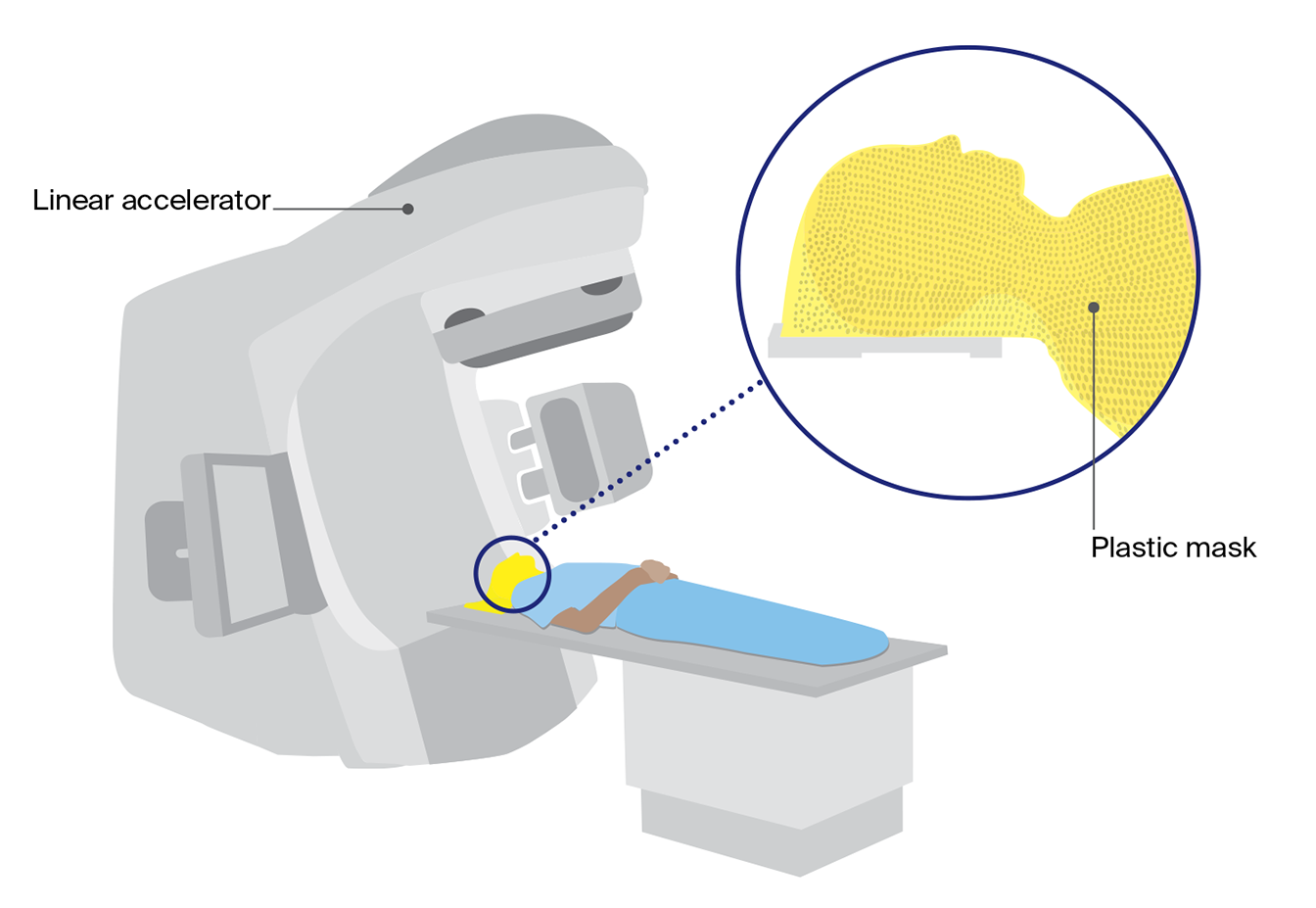
Radiation therapy is carefully planned to make sure enough radiation reaches the cancer, while as little as possible reaches healthy organs and tissues. During treatment sessions, you will lie on a table under a machine called a linear accelerator, which precisely delivers the radiation. The treatment is painless and is usually given Monday to Friday for 6–7 weeks. You usually won’t need to stay in hospital.
You wear the plastic mask for about 10–20 minutes at each session. It helps you keep still and makes sure the radiation is targeted at the same area at each treatment session. You can see and breathe easily, but it may feel strange and confined at first. Tell the radiation therapists if you have claustrophobia or the mask makes you feel uncomfortable – you can talk to someone or may be offered medicine to help you relax.
Radiation therapy side effects vary depending on the area treated, the number of sessions, and whether it is combined with chemotherapy. Side effects often get worse 1–3 weeks after treatment ends and then start to improve. Some side effects may last longer, be ongoing or appear several months or years later. Some may be permanent. It is important to talk to your treatment team if you have any concerns or questions on how the treatment may affect you. The most common short-term and long-term side effects are listed below.
Learn about managing side effects and the health professionals who may be able to help.
Short-term side effects can include fatigue, mouth sores, taste changes, nausea, loss of appetite, mouth infection (oral thrush), dry mouth, thick saliva and phlegm, swallowing difficulties, skin redness, burning and pain in the area treated, breathing difficulties and weight loss.
Longer-term or permanent side effects may include dry mouth, thick saliva, difficulties with swallowing and speech, changes in taste, fatigue, muscle stiffness, neck swelling, appetite and weight loss, mouth infection (oral thrush), hoarseness, dental problems such as tooth decay and gum disease, difficulty opening the mouth, and hair loss.
Some people develop a temporary or ongoing problem where fluid or food enters the windpipe (trachea) while swallowing. This is called aspiration and it can cause coughing, lung infections such as pneumonia and, sometimes, difficulty breathing.
If the treatment damages the thyroid, it can cause an underactive thyroid (hypothyroidism). This can be managed with thyroid hormone replacement tablets.
Radiation therapy can damage blood vessels, reducing the blood supply to the area treated. Occasionally, the bone starts to die, leading to pain, infection and fractures. This is known as osteoradionecrosis, or ORN. About 5–7% of people who have radiation therapy to the head and neck develop ORN of the jaw. It can occur months or years later, most commonly after having dental work such as the removal of teeth, when the bone is unable to heal itself. This is why you will usually see a dentist before your cancer treatment, so any dental issues can be treated before there is a risk of ORN.
It is very important to tell your dentist that you have had radiation therapy before beginning any dental work. Treatment for ORN may include antibiotics, other medicines or surgery. To help the bone heal, some people may also have hyperbaric oxygen treatment (breathing in concentrated oxygen in a pressurised chamber).
Head and Neck Cancer Australia
Services offered
Find the right services for your needs, wherever you are in Australia
Trusted cancer information for all people affected by cancer
We're available 9am - 5pm, Monday to Friday (excluding public holidays)