

Leukaemia Foundation
Services offered
Cancer information
Financial support and information
Emotional support
+3
Common tests to diagnose chronic myeloid leukaemia (CML) include blood tests and taking a sample of bone marrow for testing (biopsy).
The bone marrow sample is tested for gene changes such as the Philadelphia chromosome, which most people with CML have.
The test results show how far the leukaemia has progressed. This is called staging.
Chronic myeloid leukaemia (CML) affects the white blood cells called granulocytes (which are part of the myeloid family). A combination of the following tests will help work out whether you have CML. You may have a CT scan or ultrasound to confirm the diagnosis.
A sample of your blood will be sent to a laboratory for a full blood count. This measures the number, size and maturity of each type of blood cell. A specialist doctor called a pathologist will look at the sample under a microscope to check for leukaemia cells.
A bone marrow biopsy is used to confirm that you have CML and to check how many blood cells are affected. During a bone marrow biopsy, the doctor uses a thin needle to remove a small amount of bone marrow, usually from your hipbone (pelvic bone). You will be given a local anaesthetic to numb the area, or light sedation to help you feel relaxed.
Although it can take up to 30 minutes to prepare for the biopsy, the actual procedure takes only a few minutes. It will be uncomfortable, but you may also be given pain medicine. Pain medicine may make you feel drowsy, so arrange for someone to drive you home afterwards. The bone marrow sample is tested at a laboratory and the results will usually be available within a week.
Every kind of cancer, including blood cancer, changes the genes of the affected cells. These gene faults are not the same thing as genes passed through families. The fault is only in the leukaemia cells, not in the normal cells.
Doctors use the blood or bone marrow sample to check for gene faults in leukaemia cells. Genetic tests may include:
For CML, the most common gene fault is the presence of the Philadelphia chromosome, which results in the formation of the abnormal BCR-ABL gene. The PCR test is used again during treatment to check how well you are responding, and whether you need a change in treatment.
Some people also have an ultrasound to check the size of the spleen and liver. This scan uses soundwaves from a handheld device called a transducer that is moved over your belly area. The soundwaves echo when they meet something solid, such as an organ, and a computer turns the echoes into pictures. Talk to your medical team for more information.
Most cells in the human body have 23 pairs of chromosomes. Chromosomes are threadlike structures that contain sets of instructions known as genes.
In nearly all people with CML, chromosome 22 is abnormal and is known as the Philadelphia chromosome. A genetic test on a bone marrow sample is used to detect the Philadelphia chromosome.
The Philadelphia chromosome is not inherited and cannot be passed on to your children – it is a genetic change that happens to some people during their lifetime. This chromosome contains the BCR-ABL gene (see diagram below).
BCR-ABL is considered a cancer gene because it is present only in developing leukaemia cells. It switches on one of the proteins of the leukaemia cells, called tyrosine kinase. This protein tells leukaemia cells to grow and multiply.
All people with CML are treated with drugs to block tyrosine kinase.
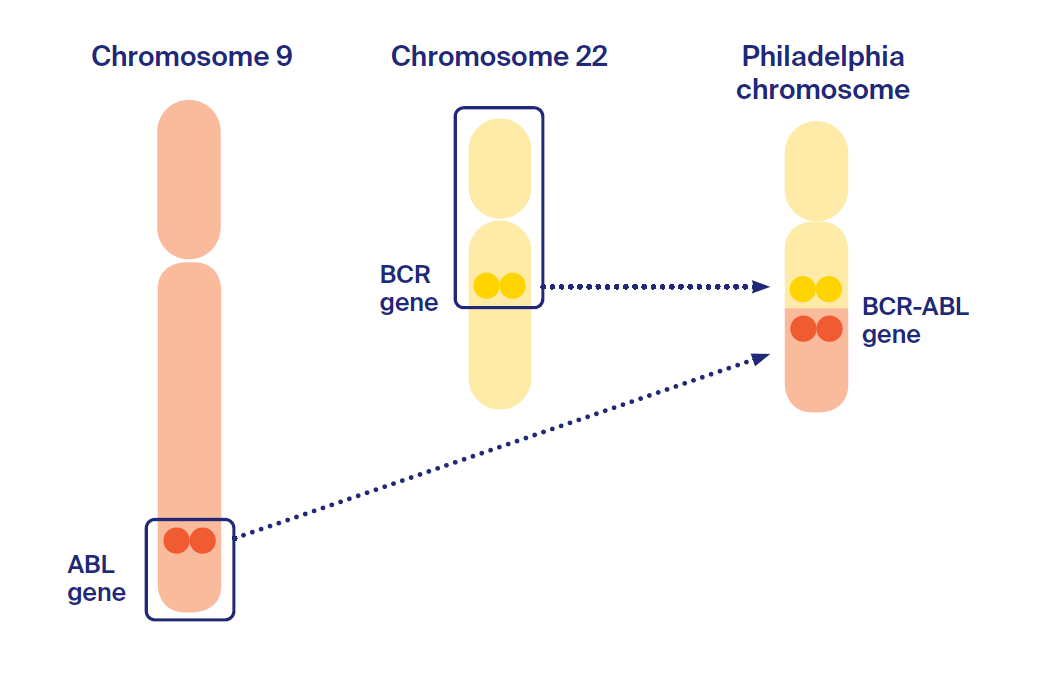
The Philadelphia chromosome is formed when parts of 2 chromosomes beak off and switch places. A gene from chromosome 22, called BCR, and a gene from chromosome 9, called ABL, create the BCR-ABL gene.
The CML tests allow the doctor to work out how far the leukaemia has progressed. This process is called staging, and it helps the doctor recommend the best treatment for you.
CML is classified into 3 groups, which are called phases instead of stages. The phases are based on the number of immature white blood cells found in the blood and bone marrow.
Most people have chronic phase CML when diagnosed. They stay in this phase for a few years without treatment. With treatment, the disease can go into remission and people with well-controlled CML can have a normal life span. If the disease progresses, it doesn’t always do it in a step-by-step way. In some cases, it moves straight from chronic to blast phase, skipping the accelerated phase.
Chronic – The white blood cell count is increased and a small number of immature cells called blast cells are found in the blood and bone marrow.
Accelerated – After several years, the number of blast cells may suddenly increase. At this time, your spleen may become enlarged and your white blood cell count may rise rapidly.
Blast – The number of blast cells significantly increases, symptoms worsen, and blast cells often spread to other organs. This is sometimes called blast crisis. Bleeding, infections and anaemia can occur.
Prognosis means the expected outcome of a disease. It is not possible for anyone to predict the exact course of the disease, but your medical team can give you an idea about how the CML will respond to treatment. Factors used to assess your prognosis include the phase of the disease, your blood counts and if your spleen is enlarged. Your team will also arrange tests throughout your treatment to check how well the CML is responding.
Recent advances in how CML is treated have dramatically improved outcomes. For most people, the goal of treatment is to get the disease into remission. If the CML does move into the accelerated or blast phases, treatment does become more challenging, but there are still good treatment options available.
Leukaemia Foundation
Services offered
Find the right services for your needs, wherever you are in Australia
Trusted cancer information for all people affected by cancer
We're available 9am - 5pm, Monday to Friday (excluding public holidays)