

BEAT Bladder Cancer Australia
Services offered
Cancer information
Emotional support
Talking with others who have had cancer
The most common procedure to collect and store urine (urinary diversion) is a urostomy. The information in this section is about other types of urinary diversion.
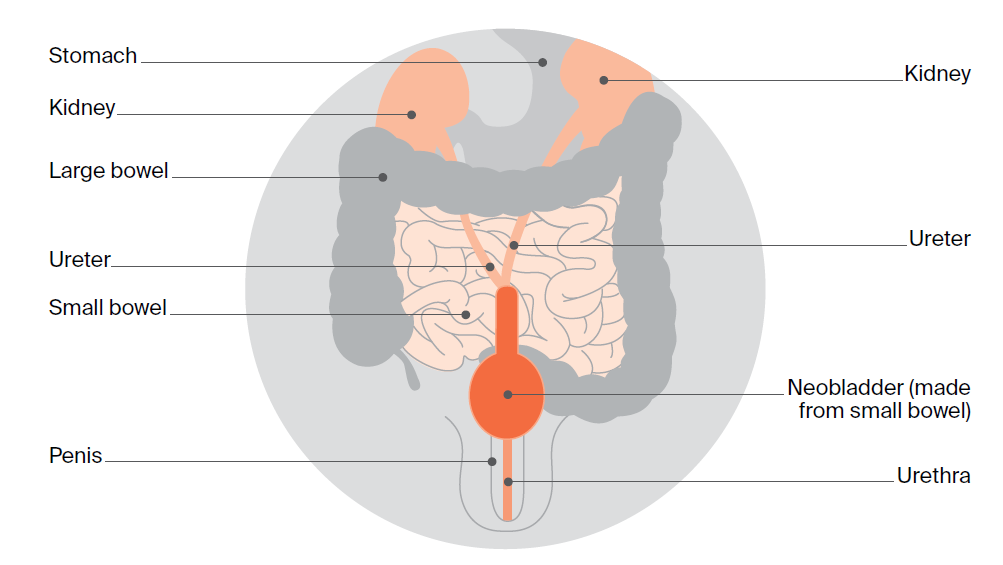
A neobladder is a new bladder made from a portion of your small bowel. The neobladder is placed in the same area as your original bladder and allows you to urinate.
Continent urinary diversion is a procedure that creates a pouch inside the body to store urine. This pouch is drained through an opening on the surface of the abdomen (a stoma).
Your treatment team will help you adjust to life with a neobladder or continent urinary diversio
In this method, a pouch is created from a portion of your small bowel and placed in the same area as your original bladder. This pouch is called a neobladder. The procedure for creating a neobladder is more complex and takes longer than creating a urostomy. However, you don’t need to have a stoma with a neobladder.
Once the neobladder is created, the surgeon will stitch it into the ureters to collect and store urine from the kidneys. It will also be stitched into the urethra to drain urine from the body. The neobladder will allow you to urinate through your urethra, but it will feel different from urinating with a normal bladder. Learn more about living with a neobladder.
It takes time to get used to a new bladder. The neobladder will not have the nerves that tell you when your bladder is full, and you will have to learn new ways to empty it.
The neobladder may produce a thick white substance (mucus), which might appear as pale threads in the urine. The amount of mucus will lessen over time, but it won’t disappear completely.
Discuss any concerns with your nurse, physiotherapist, GP or urologist, and arrange follow-up visits with them.
They will work with you to develop a toilet schedule to train your new bladder. At first, the new bladder won’t be able to hold much urine and you will probably need to empty your bladder every 2–3 hours. This will gradually increase to 4–6 hours, but it may take several months. During that time, the neobladder may leak when full, and you may have to get up during the night to go to the toilet.
Strengthening the pelvic floor muscles before and after surgery will help you control the neobladder. A continence or pelvic health physiotherapist can teach you exercises.
It can sometimes be difficult to fully empty the neobladder using your pelvic floor muscles. If this is an issue, a continence nurse will also teach you how to drain the bladder with a catheter. This is called intermittent self-catheterisation and it should usually be done twice a day to reduce the risk of urinary tract infections.
This scheme is operated by Services Australia (Medicare) and provides a payment to eligible people who need a long-term supply of continence aids, including catheters for draining the bladder. You can ask the continence nurse if you’re eligible. Visit Services Australia to find out more, or call the CAPS team on 1800 239 309.
Call 1800 33 00 66 to speak to a nurse continence specialist or visit Continence Health Australia for more information.
In this procedure, the surgeon uses a piece of the small bowel to create a pouch inside the body. The pouch is designed so that it does not leak urine, but can be drained by inserting a catheter through a stoma (an opening on the surface of the abdomen). Several times a day you will need to drain the urine by inserting a drainage tube (catheter) through the stoma into the pouch.
This diversion procedure is not commonly used, but may be an option in some circumstances. Your surgeon or nurse will explain the risks and benefits of this procedure, and how to empty urine from the pouch.
BEAT Bladder Cancer Australia
Services offered
Bladder Cancer Australia Charity Foundation
Services offered
Find the right services for your needs, wherever you are in Australia
Trusted cancer information for all people affected by cancer
We're available 9am - 5pm, Monday to Friday (excluding public holidays)