

Australian Cancer Trials
Cancer Australia
Services offered
Information about clinical trials
Clinical trials are a type of clinical research where volunteers help test new methods to see if they are safe, effective and better than current options.
A common type of clinical trial is a randomised controlled trial, where one group receives the experimental treatment, while the other group receives the current standard treatment.
Learn more below about who can participate in clinical trials and who works on them.
Cancer research has led to the medical treatments and health programs available today. These advances have improved outcomes for people with all types of cancer over the past 20 years, with increases in both length of survival and quality of life. The search for better ways to prevent, diagnose and treat cancer is ongoing.
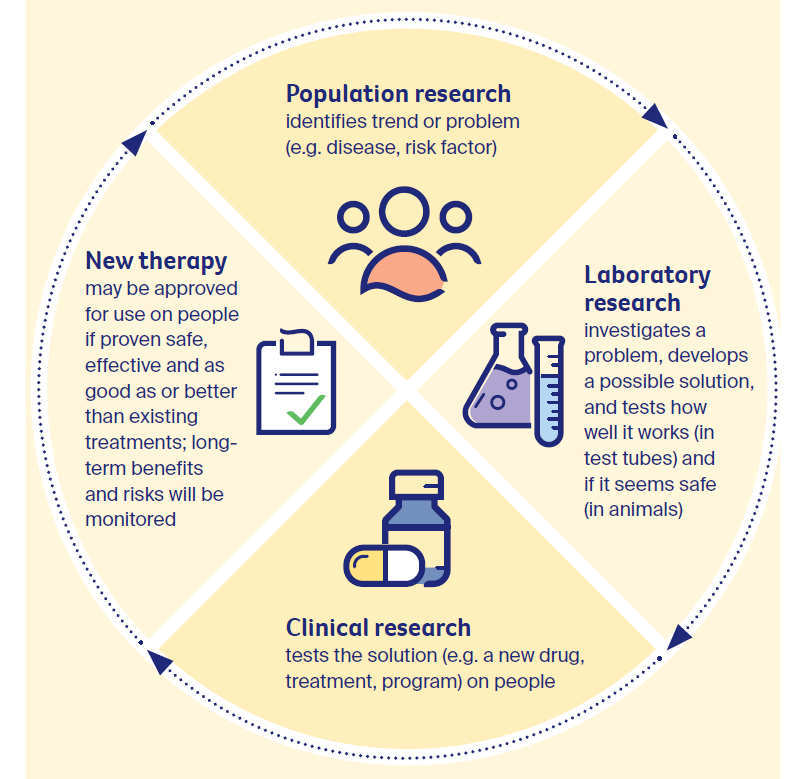
There are three main types of cancer research:
Population research and laboratory research are often the starting point for clinical research, which may involve clinical trials.
A clinical trial can help show whether a new approach to prevention, screening, diagnosis or treatment works better than current methods and is safe. People volunteer to help test how well the new way works and if it causes side effects or other problems. If the new way is shown to work better than the existing method, it may become available. Some clinical trials compare existing approaches to see which one is more effective. See Clinical trials explained for more information.
The research process is a continuous cycle. People affected by cancer mainly take part in clinical trials, a type of clinical research. Research can lead to new and improved therapies becoming part of standard care.
When cancer patients, carers and survivors, as well as people not affected by cancer, take part in research, it helps researchers learn more about cancer and ways to treat and prevent it.
Many people diagnosed with cancer who join a clinical trial or another research study do so because they want to help improve outcomes for others in the future, as well as for themselves.
Adults and children can take part in different ways, including:
All research studies, including clinical trials, have guidelines setting out who can take part. These are known as the eligibility criteria.
Most cancer research involves current patients, but some studies focus on cancer survivors, carers, family members, people at risk of cancer or people who have not been affected by the disease. Anyone under the age of 18 needs permission from a parent or guardian before joining a research study.
To make sure results reflect Australia’s diverse population, it is important that research involves people of all ages, genders and sexualities, as well as people from a wide range of social, economic, racial and cultural backgrounds.
Find out more about taking part in clinical trials or other types of cancer research.
Cancer research is carried out in many places, including hospitals, treatment centres, laboratories and universities.
Sometimes you can be involved in cancer research from home. For example, you might have treatment or medicines mailed to you, or you might be asked to fill in a survey or complete a telephone or face-to-face interview.
In Australia, some people are now taking part in clinical trials that use telehealth. This means that the research team use telephone or video calls to talk with patients and with local health professionals who are delivering part of the trial.
Clinical trials that use telehealth are sometimes called tele-trials. They were developed to make joining a clinical trial easier for people in rural and remote locations, but they can make it more convenient for anyone to take part.
You can talk to your cancer specialist about whether there is a tele-trial you could join. If you are already involved in a clinical trial, you could ask if parts of it can be delivered by telehealth.
A team of people work on clinical trials, and some of their roles overlap. If you decide to join a clinical trial, you may have contact with all or some of the people listed here. In most cases, your cancer specialist will continue to look after your overall cancer care while you are on the clinical trial.
There are many advantages to being involved in a clinical trial or other research study. Depending on the type of research, the benefits may include:
Your doctor and the clinical trials or research nurse will discuss the possible advantages and disadvantages for you before you join a research study. Taking part in research doesn’t always mean you will be better off than before or compared with other people in a similar situation. Some people may not respond in the way researchers hope and will not benefit from being involved in the research.
In some clinical trials, people are divided into two groups. Only one group receives the experimental treatment, while the other group receives the current standard treatment (see Randomised controlled trials). You won’t get to choose which treatment you have, but either way you will be monitored more frequently and closely than usual.
The Australian Government provides useful information for people who are considering joining a clinical trial – visit Australian Clinical Trials.
Understandably, people want to know if there are any risks to taking part in research. Researchers must follow strict guidelines to make sure clinical trials and other research studies are as safe as possible for everyone involved. This is called their duty of care.
Before any research involving people can begin, it must be approved by a special group known as a human research ethics committee. As part of this process, researchers identify risks that might occur, such as possible side effects. They must also explain how they will closely monitor these risks and what will be done if problems occur. Before you agree to take part in research, you must be told about the risks, how you will be monitored for problems, and what will be done to help you if problems occur. For more information, see Informed consent.
To reduce the risks, clinical trials are arranged in a series of steps known as phases. See Phases of a clinical trial for information about the different phases of a clinical trial.
From start to finish, clinical trials and other research studies may take several months or many years, but you may only need to be involved for some of this time. For example, you might just have a single appointment lasting a couple of hours, or you may go to appointments every few weeks, months or years. You may also have to do surveys at regular times. The participant information will set out what you would need to do and how long you would be involved.
Studies have what is known as a recruitment phase. This involves finding people to enrol in the study. It usually occurs over a few months or years until the required number of people have agreed to take part. The study is then closed to new participants.
After the treatment stage is over, there may be a follow-up phase. People may be followed up at set intervals for months or years. This allows researchers to understand the long-term effects of treatments, monitor the general health of the participants, and collect data about long-term survival and quality of life.
Ask your doctor whether being involved in the research will affect any other treatments you’re having or planning to have. These may include standard cancer treatments; medicines for managing treatment side effects or symptoms of cancer or other conditions; and complementary therapies such as herbal or nutritional supplements or massage.
Your doctor may suggest stopping or delaying some treatments, or adjusting them in some way (e.g. by changing the dose).
It is important to let the research team know about any other medicines, supplements or complementary therapies you are having, as these may interact with the treatment being tested and cause harmful side effects.
Joining a clinical trial or other research study is free for Australian citizens and residents, and you should not be asked to pay to join.
The cost of trial-related treatment, tests and check-ups will be paid for by the organisation that is funding or conducting the research, sometimes called the sponsor. You will usually still have to pay for any treatments or tests you would normally pay for as part of your standard care. The participant information will outline any extra costs to you.
People participating in cancer research usually don’t get paid. This is because offering people money to join a clinical trial may put too much pressure on them to agree.
In some circumstances, you may be paid back for certain expenses (e.g. for travel, parking, light refreshments). These are known as out-of-pocket costs. The participant information will outline what expenses will be covered.
You may be interested in joining multiple clinical trials and other research studies. Check with the research team whether you can be part of more than one study at the same time. If you can, think about whether you’ll be able to commit to all the requirements of the studies. With clinical trials for medicines, you can usually only join one trial at a time.
Australian Cancer Trials
Cancer Australia
Services offered
Find the right services for your needs, wherever you are in Australia
Trusted cancer information for all people affected by cancer
We're available 9am - 5pm, Monday to Friday (excluding public holidays)