
Overview
Reproduction is how males and females produce babies. Fertilisation is when a female’s egg (ovum) combines with a male’s sperm.
Factors that affect fertility include age, weight, smoking and some medicines and cancer treatments. As females get older, the ovaries stop producing eggs and periods stop. This is called menopause.
What’s on this page

Reproduction is the way we produce babies. Knowing how your body works may help you understand how fertility problems happen.
How reproduction works
The female and male reproductive systems work together to make a baby. The process involves combining an egg (ovum) from a female and a sperm from a male. This is called fertilisation.
Role of hormones
Hormones are substances produced naturally in the body. Hormones control many body functions, including how you grow, develop and reproduce. Oestrogen and progesterone, often called female sex hormones, are produced in the ovaries. These hormones control the growth and release of eggs (ova), and the timing of menstruation (periods).
Androgens are often called male sex hormones. The major androgen is testosterone, which is produced mainly in the testicles and helps the body make sperm. Most people produce some testosterone, although generally men make more.
Ovulation
Each month, from puberty (sexual maturation) to menopause (when periods stop), one of the ovaries releases an egg. This is called ovulation.
Pregnancy
The egg travels from the ovary into the fallopian tube. Here it can be fertilised by a sperm. Once the egg is fertilised, it implants itself into the lining of the uterus and grows into a baby. After the egg is fertilised by the sperm, it’s called an embryo.
Menopause
As females get older, hormone levels fall to a level where the ovaries stop releasing eggs and periods stop. This is known as menopause. This is the natural end of the female reproductive years and it usually happens between the ages of 45 and 55.
Factors that affect fertility
Some of the common factors that affect fertility include:
- age – fertility starts to naturally decrease with age
- weight – being very underweight or overweight
- smoking – both active and second-hand smoking can harm reproductive health
- alcohol – drinking too much alcohol may make it harder to conceive
- medicines – some medicines and cancer treatments affect fertility
- other health concerns – endometriosis, fibroids, pelvic disease, certain hormonal conditions, some genetic conditions or cancer.
Transgender, non-binary or intersex?
The information in this section has been developed based on evidence in people born female or male.
If you are non-binary or trans or a person with an intersex variation, this information may still be relevant to you if you have ovaries, a cervix and a uterus, or testicles and a penis.
Cancer Connect's LGBTQIA+ cancer resources includes a section on fertility. Call 13 11 20 to ask for a copy.
For fertility information specific to your situation, talk to your healthcare team.
Female sex organs and reproduction
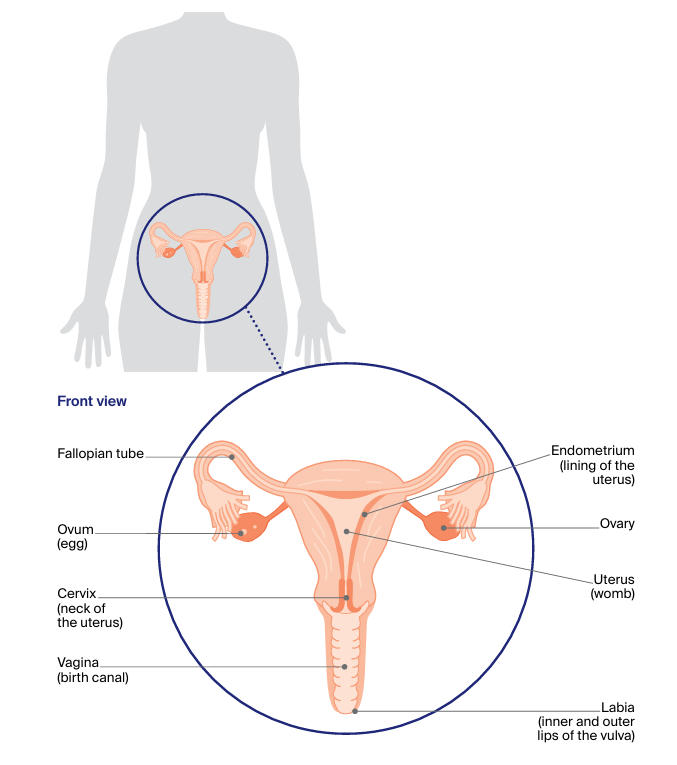
Ovaries
- 2 small, walnut-shaped organs in the lower part of the abdomen (belly)
- contain follicles that hold immature eggs (ova), which eventually become mature eggs
- make hormones including oestrogen and progesterone
Fallopian tubes
- 2 long, thin tubes that extend from the uterus and open near the ovaries
- carry sperm to the eggs, and eggs from the ovaries to the uterus
Uterus (womb)
- a hollow muscular organ where a fertilised egg (ovum) is nourished to develop into a baby
- the inner lining of the uterus is known as the endometrium; each month if an egg is not fertilised, some of the lining is shed and flows out of the body (menstruation or monthly period)
- joined to the vagina by the cervix
Cervix (neck of the uterus)
- the lower, cylinder-shaped entrance to the uterus
- produces moisture to lubricate the vagina
- holds a developing baby in the uterus during pregnancy and widens during childbirth
Vagina (birth canal)
- a muscular tube or canal that extends from the opening of the uterus (the cervix) to the vulva
- the passageway through which menstrual blood flows out of the body, penetrative sex (such as intercourse) occurs and a baby is born
Vulva
- the external sex organs; includes the labia
Male sex organs and reproduction
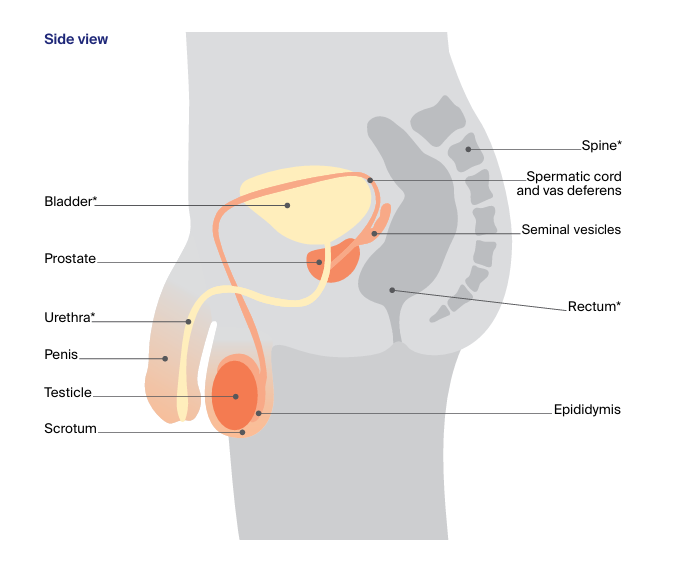
*Not part of the male reproductive system
Testicles (testes)
- 2 small, egg-shaped glands
- make and store sperm
- also make the hormone testosterone
Scrotum
- the loose pouch of skin at the base of the penis that holds the testicles
Epididymis
- a tightly coiled tube attached to the outer surface of each testicle
- sperm travel from the testicles through the epididymis to the spermatic cordspermatic cord and vas deferens
- tube running from each testicle to the penis
- contains blood vessels, nerves and lymph vessels
- carries sperm towards the penis
Seminal vesicles
- a pair of glands that lie close to the prostate
- produce fluids that make up part of semenprostate
- a small gland about the size of a walnut
- produces fluids that form part of semen
- located near the nerves, blood vessels and muscles that control bladder function and erections
Penis
- the main external sex organ
- urine and semen pass out of the body through the penis
- semen is made up of sperm and fluids, and is ejaculated from the penis
Find support services
Find the right services for your needs, wherever you are in Australia
Read cancer information
Trusted cancer information for all people affected by cancer
Need to talk to someone?
We're available 9am - 5pm, Monday to Friday (excluding public holidays)