

Rare Cancers Australia
Services offered
Cancer information
Support from cancer nurses
Support from other health professionals
+6
A rare or less common (RLC) cancer is a type of cancer that affects a small number of people. An RLC cancer may take longer and be more difficult to diagnose than other types of cancer. It may also be found at a late stage (advanced).
Breast, bowel, prostate and lung cancer are examples of common cancers. Many people are diagnosed with these types of cancers.
Small bowel and gallbladder cancer are examples of rare or less common cancers. Few people are diagnosed with these types of cancers.
A cancer may be considered an RLC cancer when it:
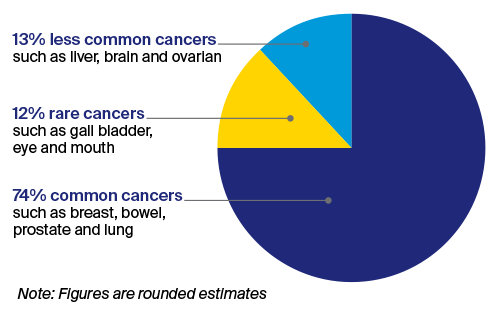
A rare cancer means fewer than 6 out of 100,000 people who are diagnosed with cancer have this type. A cancer is less common if 6 or more, but less than 12, out of 100,000 people are diagnosed with this type.
There are a large number of different types of rare or less common cancers. Although only a small number of people are diagnosed with each RLC cancer type (e.g. small bowel, gallbladder), together, they all add up to a large number.
Each year, it’s estimated about 42,000 Australians are diagnosed with a cancer that is considered to be rare or less common. About 1 in 4 people diagnosed with cancer will have an RLC cancer.
The number of people diagnosed with an RLC cancer is increasing. While the incidence of certain RLC cancer types may be on the rise, this overall increase in numbers may also be partly due to:
Any cancer affecting children and teenagers is considered rare. This is because it is unusual for younger people to have cancer. The same type of cancer found in an adult may not be considered rare. For more information about children and cancer, visit Cancer Australia's children's cancer pages.
Rare Cancers Australia
Services offered
Australian Cancer Trials
Cancer Australia
Services offered
Find the right services for your needs, wherever you are in Australia
Trusted cancer information for all people affected by cancer
We're available 9am - 5pm, Monday to Friday (excluding public holidays)